Baroque · French
Jacques Boyvin
around 1649 to 1706
French Classical
Core repertoire
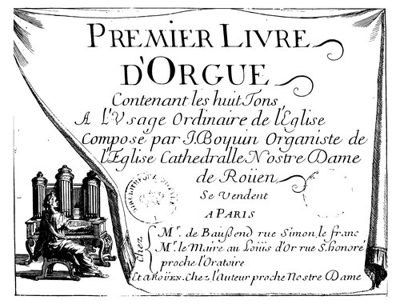
Image: BnF (Gallica btv1b9009930b), domaine public
Organist of Rouen Cathedral for over thirty years, Jacques Boyvin published two books of organ music (1689-1690 and 1700) that brilliantly exemplify the French classical style. His writing is characterized by a great nobility of tone.
The repertoire
Works in the project’s repertoire
5 works, all available to listen to.
Core repertoire
This classification reflects the place of these repertoires within the artistic and educational orientations of the project. It does not constitute a technical indication regarding the design of the instrument.
Biography
Life and organ music
Jacques Boyvin was probably born in Paris in the early 1650s and died in Rouen on 30 June 1706. Organist of Rouen Cathedral for thirty-two years, in the post once made famous by Titelouze, he oversaw the building of a large new organ there by Robert Clicquot. His two organ books, of 1689 and 1700, contain a hundred and twenty pieces in the eight tones; their prefaces, on the mixing of stops and then on accompaniment, are among the main witnesses to organ practice under Louis XIV.
Key dates
- c. 1649–1655
- Born, probably in Paris (date debated)
- January 1663
- Organist of the Hôpital des Quinze-Vingts
- 17 August 1674
- Organist of Rouen Cathedral, after competition (according to Dufourcq)
- 25 June 1683
- A storm damages the cathedral organ
- 20 June 1689
- Completion of Robert Clicquot’s organ
- 1689
- First organ book
- 1700
- Second organ book and Traité abrégé de l’accompagnement
- 30 June 1706
- Death in Rouen
The Quinze-Vingts
His date of birth is not known. The English and German Wikipedia articles give c. 1649, the French article between 1649 and 1655, Musicologie.org c. 1653, and a study published in 1988 in the Revue de musicologie has “1655?”. He studied in Paris, perhaps, according to Norbert Dufourcq, with Michel de La Guerre, organist of the Sainte-Chapelle; he very probably knew André Raison and Nicolas Lebègue, whose pupil some historians believe him to have been.
He was trained at the Hôpital des Quinze-Vingts, the hospice for the blind, where his father lived according to Musicologie.org. He became its organist in January 1663 and remained so until 1673, or 1674 according to Musicologie.org; his brother Gabriel succeeded him in 1678.
Rouen Cathedral
On the death of the organist Germain Yart, the Rouen chapter held a competition in playing and composition. Boyvin won it and was appointed, according to Dufourcq, on 17 August 1674; Musicologie.org gives July 1674. He kept the post until his death. The organ he found, Titelouze’s, had been restored by Crespin Carlier in 1601, then repaired and enlarged between 1657 and 1660 by Pierre Thierry and Pierre des Enclos. On 25 June 1683 a violent storm damaged it: the French article speaks of partial destruction by the collapse of a vault, the German article of its destruction.
Robert Clicquot then built a new instrument with four manuals and pedal; the German article gives it forty-two stops and a pedalboard of thirty notes, and mentions the great case entrusted to the Parisian joiner Joseph Pilon. Boyvin oversaw the work, completed on 20 June 1689. He married in Rouen in August 1680; a daughter was born on 10 September 1681. From 1697 to 1702 he also played the organ of Saint-Herbland, built in 1685 by Clément and Germain Lefebvre and moved in 1791 to Saint-Michel in Bolbec, according to Musicologie.org. A sought-after expert, he worked with Clicquot, the Lefebvres, Alexandre Thierry and Robert Ingoult, and was called in on building projects as well as in disputes.
Two organ books
The Premier livre d’orgue contenant les huit tons à l’usage ordinaire de l’Église appeared in 1689; Musicologie.org dates it 1689–1690. It opens with an Avis au public concernant le mélange des jeux de l’orgue, les mouvements, les agréments et le toucher. The second book, in 1700, is preceded by a Traité abrégé de l’accompagnement pour l’orgue et pour le clavecin, reprinted on its own in Paris in 1705 and in Amsterdam around 1708–1710, translated into Dutch and cited by Heinichen in 1728. Each book comprises eight suites, making a hundred and twenty pieces in sixteen suites.
Boyvin takes up the forms developed by Lebègue and Nivers: preludes, pleins jeux, fugues, duos, trios, récits, basses de trompette, dialogues, grands jeux. The German article notes some novelties, the concert pour les flûtes and dialogues interspersed with trio episodes, as well as a taste for chromaticism that he shared with Gilles Jullien at Chartres; well-handled dissonances, he wrote, make “the beauty and ornament of music”. The purpose of the pieces is debated: the French article calls them liturgical, the German article written to show off the stops of the new instrument rather than for the service. Alexandre Guilmant and André Pirro published them in 1905 in the Archives des maîtres de l’orgue.
The end
In 1700 he was a witness at the wedding of Gaspard Corrette, a Rouen organist who occasionally deputised for him. He died on 30 June 1706 and lies in the cathedral, not far from Titelouze. His pupil François d’Agincourt succeeded him in the organ loft. Jacques Duphly was his grandson.
The sources
Digitised collections
Early editions and manuscripts containing works by this composer, digitised by libraries and available in full.
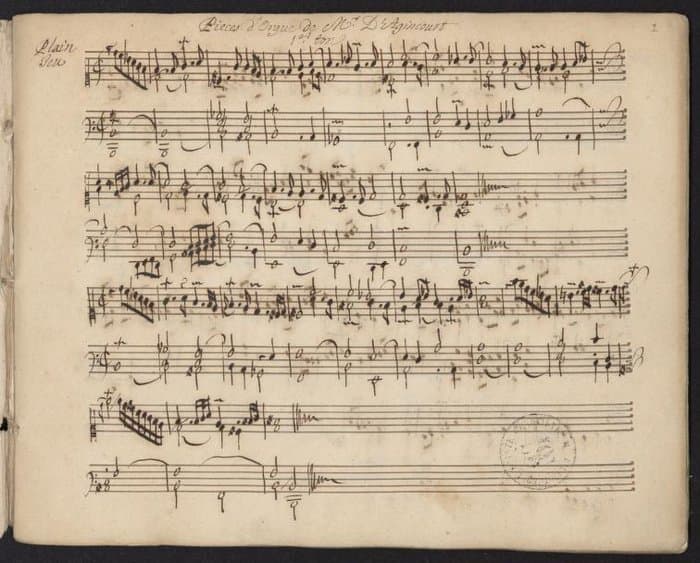
Pièces d’orgue de François d’Agincourt, de Jacques Boyvin et d’anonymes, copiées par le P. Pingré
Manuscript, [second half of the 18th c.]
Copy: Bibliothèque Sainte-Geneviève (Ms. 2372), via Internet Archive
Take part
This organ will be able to serve this music.