Chaumes-en-Brie, c. 1626 · Paris, 1661
Louis Couperin, 1626 – 2026
Four centuries after his birth in Chaumes, the first of the Couperins.
Louis Couperin was born in Chaumes-en-Brie around 1626. A harpsichordist, organist and viol player, he was the first musician of the family to make his name in Paris, where he died on 29 August 1661, aged thirty-five. His Parisian career lasted barely ten years.
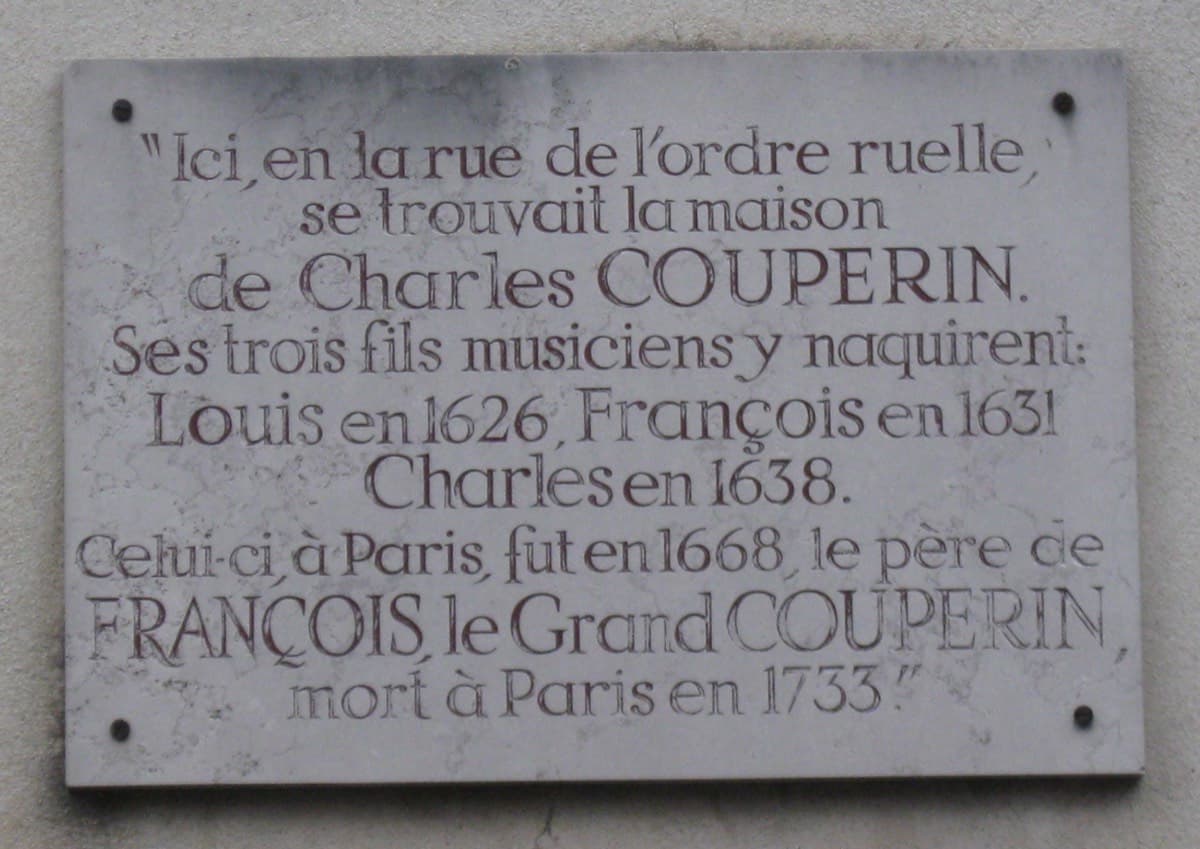
He was the eldest of three musician brothers, sons of Charles Couperin and Marie Andry. Nothing is known of his youth or training. Even the year of his birth is only approximate; the plaque in Chaumes gives 1626.
Key dates
- c. 1626
- Born in Chaumes-en-Brie
- c. 1650
- Serenade for Chambonnières, then departure for Paris
- 9 April 1653
- Organist of the church of Saint-Gervais
- 22 October 1655
- Godfather to his sister’s child, in Chaumes
- 1656
- Stays in Meudon, where several organ pieces are dated
- 1659
- Journey to Toulouse with the court
- 29 August 1661
- Death in Paris
The encounter
The serenade of Saint James’s Day
The story is told by Évrard Titon du Tillet in Le Parnasse françois, in 1732. On the feast of Saint James, Louis Couperin and his two brothers, François and Charles, went to serenade Jacques Champion de Chambonnières, musician to the King, on his name day. Chambonnières was then at Le Plessis-Feu-Aussoux, a village in Brie close to Chaumes, where his wife owned a property.
Pleasantly surprised, Chambonnières asked who these young men were and invited them to his table. The pieces played were by the eldest. Struck by his talent, he became his teacher, persuaded him to settle in Paris and introduced him at court. By 1651 Louis Couperin was already living in the capital.
Paris
Saint-Gervais and the court
On 9 April 1653 Louis Couperin became organist of the church of Saint-Gervais, one of the most prominent posts in the kingdom. He was paid four hundred livres a year, with lodgings. He shared the organist’s lodgings with his two brothers during his last years.
According to Titon du Tillet, he was offered Chambonnières’s place as harpsichordist to the King. He refused, out of loyalty to the man who had made him known. He then entered the King’s service as a treble viol player.
Johann Jacob Froberger was in Paris at the same period. A meeting is likely, but no document proves it. Both composed a tombeau for the lutenist Blancrocher, who died after falling down a staircase: they belonged at least to the same circle.
The works
Nothing printed in his lifetime
None of his pieces was published during his lifetime. They have come down to us in manuscript copies. The main one is the Bauyn manuscript, held at the Bibliothèque nationale de France and copied around 1690: it contains one hundred and twenty-two harpsichord pieces, four organ pieces and five chamber works.
It was through the harpsichord that Louis Couperin first entered posterity. His chaconnes and his unmeasured preludes, written in the manner of the lutenists in a notation of his own, are his most personal pages.
The organ music recovered
Seventy pieces, rediscovered in 1957
“Couperin a Meudon le 18e Juillet 1656”
Until the mid-twentieth century only a few isolated organ pieces by him were known. In 1957 Guy Oldham discovered in England a manuscript containing seventy, sixty-eight of which are found nowhere else. The collection was not published until 2003.
These pieces often bear the date, and sometimes the place, of their composition, which is exceptional for the period. The composer can thus be followed from 1650 to 1659, almost day by day.
They mark the passage from the strict counterpoint of Titelouze to the colourful style of Nivers and Lebègue. Louis Couperin was the first French composer to write for specific registrations, and the first to give the bass leaping divisions inspired by the viol: two traits that would define the French organ for more than a century.
A few scholars question, on stylistic grounds, the attribution of all these pieces to Louis Couperin.
After him
One organ loft, one family
On his death his brother Charles succeeded him at Saint-Gervais. In 1668 Charles’s only child was born: François Couperin, known as le Grand. But for one interim after Charles’s death, the post would remain in the family until the nineteenth century.
In Chaumes-en-Brie, a plaque marks the house where the three brothers were born. It is there, four hundred years later, that the organ project aims to make this music heard again.
The Couperin family treeSources
- Évrard Titon du Tillet, Le Parnasse françois, Paris, 1732.
- Louis Couperin, Pièces d’orgue, edited by Guy Oldham, Éditions de l’Oiseau-Lyre, 2003.
- Charles Bouvet, Une dynastie de musiciens français : les Couperin, organistes de l’église Saint-Gervais, Paris, Delagrave, 1919.
- Wikipedia articles “Louis Couperin” and “Jacques Champion de Chambonnières”, in French and English, consulted in November 2026.
1626 – 2026
An organ for the land of the Couperins.
Four centuries after the birth of Louis Couperin, Chaumes-en-Brie is preparing an instrument able to serve his music and that of his heirs.