Baroque · German
Samuel Scheidt
1587 to 1654
German Baroque
Repertoire in dialogue
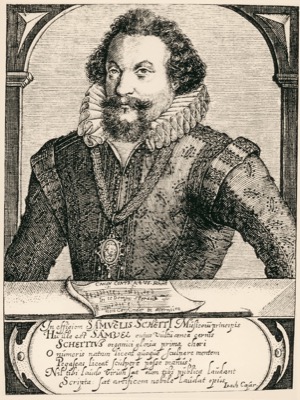
A pupil of Jan Pieterszoon Sweelinck in Amsterdam, Samuel Scheidt was court organist and then Kapellmeister in Halle, his native town. His Tabulatura nova (1624), in three volumes, is the first collection of keyboard music printed in Germany in score notation. His chorale variations, fantasias and liturgical pieces exerted an influence that extended as far as Bach.
The repertoire
Works in the project’s repertoire
6 works, all available to listen to.
Repertoire in dialogue
Flagship work
Tabulatura Nova, Vol. II — Echo ad Manuale Duplex (SSWV 128)
SSWV 128 · Echo
Echo dialogues, also dear to the French Classical organ, call for contrasting tonal planes
Flagship work
Tabulatura Nova, Vol. I — Cantio Sacra: Vater unser im Himmelreich (SSWV 104)
SSWV 104 · Chorale variations
Major variation cycle, the richness of French registrations allows for color changes between versets
Tabulatura Nova, Vol. I — Passamezzo (SSWV 107)
SSWV 107 · Variations
Character piece, the varied registrations of a French organ provide a rich palette of colors
Tabulatura Nova, Vol. I — Cantio Sacra: Wir glauben all’ an einen Gott (SSWV 102)
SSWV 102 · Chorale variations
Lutheran liturgical piece, the contrapuntal style transfers well to a French organ with foundation and reed stops
Tabulatura Nova, Vol. III — Magnificat Cycles (sélection)
SSWV 139-157 · Magnificat
Alternatim liturgical cycles comparable to French Magnificats, good compatibility with Classical registrations
Tabulatura Nova, Vol. I — Fantasia super Ut Re Mi Fa Sol La (SSWV 105)
SSWV 105 · Fantasia
Fugal fantasia on the hexachord in Sweelinck’s tradition, adaptable to foundation stops and Cromorne
This classification reflects the place of these repertoires within the artistic and educational orientations of the project. It does not constitute a technical indication regarding the design of the instrument.
The sources
Digitised collections
Early editions and manuscripts containing works by this composer, digitised by libraries and available in full.

Zeven orgelstukken (ed. Robert Eitner), from a manuscript in the library of the Graues Kloster, Berlin
Utrecht, L. Roothaan, 1871
Internet Archive
Take part
This organ will be able to serve this music.