Baroque · French
Christophe Moyreau
1700 to 1774
French Classical
Core repertoire
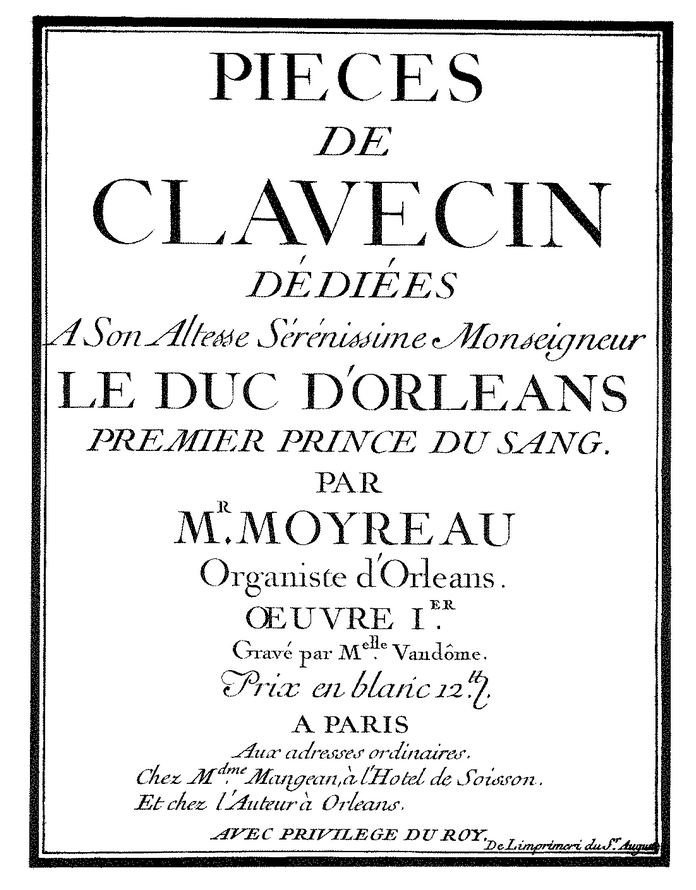
Image: Wikimedia Commons, domaine public
Organist of the collegiate church of Saint-Aignan in Orléans from 1719 to 1737 and then of Sainte-Croix Cathedral until about 1772, Christophe Moyreau published six books of harpsichord pieces dedicated to the Duke of Orléans in 1753. The fifth contains Les Cloches d’Orléans, a ’piece for organ and harpsichord’ imitating the cathedral bells.
The repertoire
Works in the project’s repertoire
1 work, available to listen to.
Core repertoire
Flagship work
Les Cloches d’Orléans, pièce pour l’orgue et le clavecin
Piece
Core project repertoire
This classification reflects the place of these repertoires within the artistic and educational orientations of the project. It does not constitute a technical indication regarding the design of the instrument.
Biography
Life and organ music
Christophe Moyreau spent his whole career in Orléans, his native city: organist of the collegiate church of Saint-Aignan from 1719 to 1737, then of Sainte-Croix Cathedral until about 1772. His known work lies almost entirely in six books of harpsichord pieces published in 1753; one of them contains Les Cloches d’Orléans, the only piece he expressly intended “for the organ and the harpsichord”.
Key dates
- 6 April 1700
- Born in Orléans (the 4th according to the English article)
- 24 February 1719
- Organist of the collegiate church of Saint-Aignan
- 1726
- Marriage to Jeanne Patenotre
- late 1737
- Organist of Sainte-Croix Cathedral (January 1738 according to the English article)
- 1753
- Six books of harpsichord pieces, including Les Cloches d’Orléans
- c. 1772
- Jean-Maurice Daubet succeeds him at Sainte-Croix
- 11 May 1774
- Death in Orléans
An Orléans family
He was born in April 1700: on the 6th according to the French Wikipedia article and Musicologie.org, on the 4th according to the English article. The French article has him born in the parish of Saint-Paul, Musicologie.org at Saint-Aignan. His family, probably long established in Orléans, was one of craftsmen: his father, Jacques, was a master shoemaker, an uncle a master vinegar-maker. Nothing connects him with the engraver Jean Moyreau, born in the same parish of Saint-Paul in 1690.
His training is not documented. He may have been a choirboy at Sainte-Croix Cathedral, whose great organ was then played by the Colesse family, or at the collegiate church of Saint-Aignan; Musicologie.org calls him “perhaps a choirboy” there. In 1726 he married Jeanne Patenotre, who died in 1746, and they had eleven children; only one, Sylvain-Marie, architect to the Comte d’Artois, outlived his father.
Saint-Aignan and Sainte-Croix
He was nineteen when, on 24 February 1719, he took over the organ of the collegiate church of Saint-Aignan, which he kept until 13 December 1737. He then moved to Sainte-Croix Cathedral, at the end of 1737 according to the French article and Musicologie.org, in January 1738 according to the English article, and remained there until about 1772, when he handed the post over to Jean-Maurice Daubet. Both churches maintained a choir of professional singers and a choir school for boys.
Like many organists, he also worked as a harpsichordist in the town. In 1762 at least he played the harpsichord in the orchestra of the Académie de musique d’Orléans, a concert society that François Giroust, master of music at the cathedral, had revived in 1757. In 1752 he bought a house in the rue du Bourg-Neuf, near the ramparts, within the jurisdiction of the chapter of Sainte-Croix; he lived there until 1773 and grew orange trees.
The books of 1753
Moyreau obtained a privilege on 30 January 1753, and his six books of harpsichord pieces appeared the same year, engraved by Marie-Charlotte Vendôme and dedicated to Louis-Philippe, Duke of Orléans, who had just succeeded his father. The French article sees them as a compilation of pieces written over a long period. The suites are of unusual length, up to twenty-six movements according to the English article: an overture, the dances, then character pieces with evocative titles. Concertos, sonatas and overtures are mixed in, and the sixth book brings together three-movement symphonies in the Italian style, a unique case in French harpsichord music.
The organ is not absent. The fifth book contains Les Cloches d’Orléans, a “piece for the organ and the harpsichord”, imitating the cathedral bells and the most often played of his works; the same book includes L’Organisée, probably intended for the clavecin organisé, which combined harpsichord and organ. In the second book, Le Purgatoire, very slow, links episodes entitled “Plaintes des morts”, “Sommeil” or “Reveil”, with the note: “This piece may be played on the organ”.
The teacher
In the same year, 1753, Ballard published his Petit abrégé des principes de musique par demandes et réponses, of which the French article lists three copies, in Orléans, at Cornell University and at the Newberry Library in Chicago (Musicologie.org mentions only one); it bears witness to his teaching. A Traité d’accompagnement du clavessin, “following the principles of M. Moreau”, appears in 1779 in the catalogue of the library of the Orléans jurist Daniel Jousse; this manuscript has not been traced.
In 1772 his name appears in the post-mortem inventory of Gabriel Huquier, a Parisian engraver and publisher also born in Orléans, with whom he exchanged letters and bills of exchange. Moyreau died in Orléans on 11 May 1774, in the parish of Saint-Pierre-Lentin, near the cathedral.
Take part
This organ will be able to serve this music.