Baroque · French
François d'Agincourt
1684 to 1758
French Classical
Core repertoire
Born and died in Rouen, d’Agincourt succeeded Jacques Boyvin as organist of Rouen Cathedral in 1706 and was also one of the organists of the Chapelle Royale. Besides a book of harpsichord pieces (1733), he left a manuscript of 46 organ pieces grouped in six suites.
Wikipedia Scores on IMSLP Report an error
Organ loftsChapelle royale
The repertoire
Works in the project’s repertoire
2 works, all available to listen to.
Core repertoire
This classification reflects the place of these repertoires within the artistic and educational orientations of the project. It does not constitute a technical indication regarding the design of the instrument.
Biography
Life and organ music
François d’Agincourt was born in Rouen in 1684 and died there on 30 April 1758. Trained by Jacques Boyvin and then, in Paris, by Nicolas Lebègue, he succeeded Boyvin in 1706 as organist of Rouen Cathedral, a post he held for more than half a century, and in 1714 became one of the four organists of the Chapelle Royale. He left a book of harpsichord pieces printed in 1733, placed wholly under the authority of François Couperin, and forty-six organ pieces known from a manuscript copy.
Key dates
- 1684
- Born in Rouen
- 6 December 1701
- Organist of Sainte-Marie-Madeleine-en-la-Cité, Paris
- 25 August 1706
- Organist of Rouen Cathedral, succeeding Boyvin
- October 1714
- One of the four organists of the Chapelle Royale
- 1713–1716
- Three airs in Ballard’s collections
- 1733
- Pièces de clavecin, dedicated to the queen
- 30 April 1758
- Death in Rouen
From Rouen to Paris
His name is spelt in several ways: d’Agincourt, Dagincourt, or d’Agincour, the form he himself used on the title page and in the dedication of his Pièces de clavecin, as Charles Bouvet noted in 1919. He received his first musical training in Rouen from Jacques Boyvin, organist of the cathedral; the German Wikipedia article and Musicologie.org present this teacher as probable. He then went to Paris, where he worked with Nicolas Lebègue, organist of Saint-Merry and of the Chapelle Royale: the English article says “probably”, Musicologie.org “certainly”.
On 6 December 1701, according to the German article, he was appointed after a competition organist of the church of Sainte-Marie-Madeleine-en-la-Cité. He remained there until September 1706. The competition held to replace him, “in place of Sieur d’Agincourt, who is leaving”, has remained famous: Jean-Philippe Rameau, judged the most skilful, declined the post because the rules forbade the new organist to keep other organ lofts, and Louis-Antoine Dornel was appointed instead.
Organist of the cathedral
Boyvin died on 30 June 1706. On 25 August following, according to the German article, d’Agincourt was appointed, again after a competition, organist of Rouen Cathedral. There he found the four-manual organ that Robert Clicquot had built between 1686 and 1689 under Boyvin’s supervision, after the previous instrument had been destroyed by a storm in 1683. He kept this post until his death fifty-two years later.
He held other posts in Rouen as well: the abbey church of Saint-Ouen, a royal abbey whose title of organist Bouvet gives him alongside those of the king’s chapel and the cathedral, and, according to the English article and Musicologie.org, Saint-Herbland and Saint-Jean. Jacques Duphly, Boyvin’s grandson according to the French article on Boyvin, studied with him around 1730–1731; the English article observes that his works show little trace of his teacher’s style.
The Chapelle Royale
In October 1714 d’Agincourt became one of the four organists of the Chapelle Royale; the German article describes him as Louis Marchand’s successor. The French article adds that he was preferred to Louis-Claude Daquin, who was younger.
A competition for the organ of the Chapelle, held before 1730, also set him against Antoine Calvière. Titon du Tillet, in the second supplement to his Parnasse françois (1755), quoted by Bouvet, relates that François Couperin was the judge, that the two talents “did not seem to yield to one another”, and that only “the greater age of M. Dagincour” led to his being preferred. Fétis, in the 19th century, saw in this choice an injustice owing to the goodwill d’Agincourt enjoyed; Bouvet countered with Titon’s account, which he considered better informed.
The organ pieces
His organ music was not printed in his lifetime. It is known from a copy made by Father Alexandre Guy Pingré, priest and scientist, which the French article and Musicologie.org place in the Bibliothèque Sainte-Geneviève, the English article in the Bibliothèque nationale de France. It contains forty-six liturgical pieces (forty-eight according to the German article), arranged by tone in six suites, as was customary in France; for unknown reasons d’Agincourt omits the third tone, and the suites in the first three tones represented, the first, second and fourth, are less developed than the others.
The English article considers these pieces more progressive than Couperin’s, with frequent elements of the galant style. The collection was published in 1956, with a preface by Ludovic Panel, and in 1992 by Nicolas Gorenstein in the series “Organa Gallica”. The Suite du deuxième ton gives a fair idea of it, with its plein jeu, récit de nasard, duo, concert de flûtes, trio and grand jeu.
The harpsichord and Couperin
In 1733, the year of Couperin’s death, he published in Paris his Pièces de clavecin, dedicated to the queen: forty-three pieces divided into four “ordres”, Couperin’s term, in which portraits and character pieces prevail over dances. The preface states: “I have changed nothing in the ornaments or in the manner of playing from that which Monsieur Couperin has so well described and characterised”. Bouvet saw in the allemande La Couperin, which reproduces an entire bar of Couperin’s allemande of the same name, a tribute to the master rather than to his daughter. A second book, announced in the preface, never appeared.
Three airs for solo voice and continuo are also known, published by Ballard in the collections of airs sérieux et à boire of 1713 and 1716. He died in Rouen on 30 April 1758; Bouvet, in 1919, gave 1757.
Sources
- Wikipedia (French), “François d’Agincourt”, consulted November 2026
- Wikipedia (English), “François d’Agincourt”, consulted November 2026
- Wikipedia (German), “François d’Agincour”, consulted November 2026
- Jean-Marc Warszawski, “D’Agincourt François, 1684-1758”, Musicologie.org, 2013
- Jean-Marc Warszawski, “Boyvin Jacques”, Musicologie.org (the organ of Rouen Cathedral)
- Wikipedia (French), “Jacques Boyvin”, consulted November 2026
- Wikipedia (French), “Louis-Antoine Dornel”, consulted November 2026 (the Madeleine-en-la-Cité competition, 1706)
- Charles Bouvet, Une dynastie de musiciens français : les Couperin, organistes de l’église Saint-Gervais, Paris, Delagrave, 1919, pp. 106 and 119–121 (Internet Archive)
- Bibliothèque nationale de France, authority record “Dagincourt, François (1684-1758)”
The sources
Digitised collections
Early editions and manuscripts containing works by this composer, digitised by libraries and available in full.
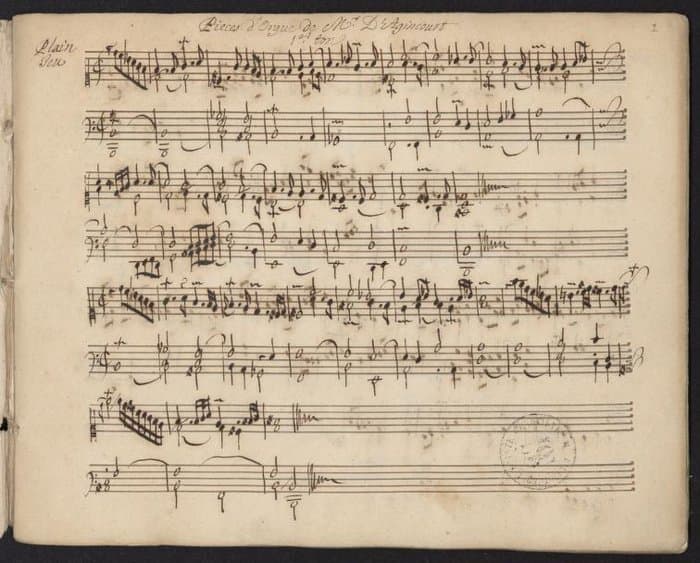
Pièces d’orgue de François d’Agincourt, de Jacques Boyvin et d’anonymes, copiées par le P. Pingré
Manuscript, [second half of the 18th c.]
Copy: Bibliothèque Sainte-Geneviève (Ms. 2372), via Internet Archive
Take part
This organ will be able to serve this music.