Baroque · French
François Roberday
1624 to 1680
French Classical
Core repertoire
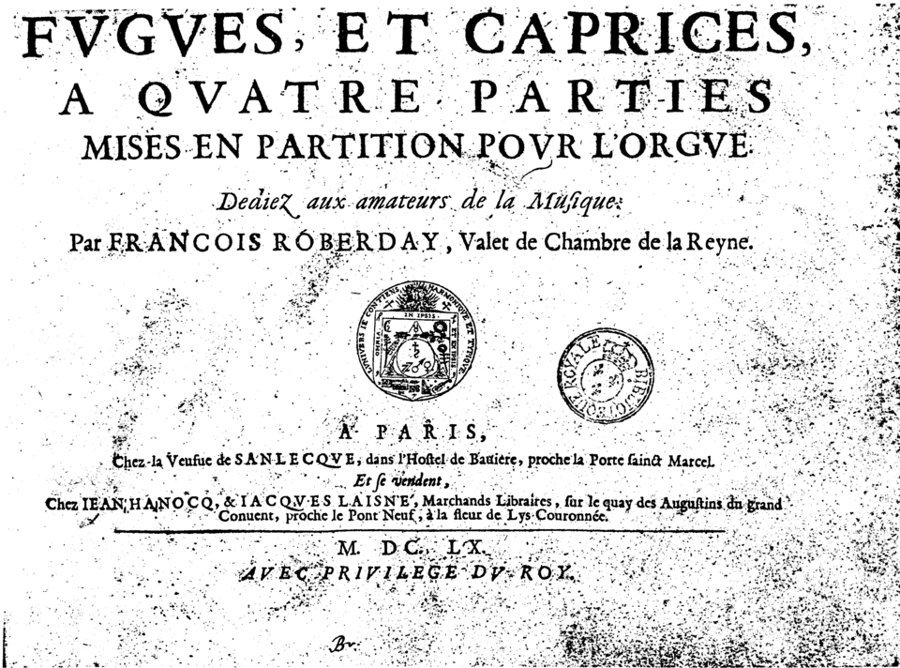
Image: Archives des maîtres de l’orgue (Guilmant et Pirro, Durand, 1901), Wikimedia Commons, domaine public
A Parisian goldsmith and organist and brother-in-law of Jean-Henri d’Anglebert, Roberday is one of the last exponents of the polyphonic tradition inherited from Titelouze. His Fugues et caprices (1660), written in four parts and also playable on viols, was the first organ collection printed in France since Titelouze’s.
The repertoire
Works in the project’s repertoire
8 works, 5 of them available to listen to.
Core repertoire
This classification reflects the place of these repertoires within the artistic and educational orientations of the project. It does not constitute a technical indication regarding the design of the instrument.
Biography
Life and organ music
François Roberday was baptised in Paris on 21 March 1624. The son of a goldsmith, himself goldsmith to the King and then valet de chambre to the Queen, he played the organ in several Parisian churches. He left a single collection, the Fugues et caprices à quatre parties of 1660: the first organ book printed in France since those of Titelouze, and one of the last witnesses to a polyphonic style that the next generation was to leave behind.
Key dates
- 21 March 1624
- Baptised in Paris
- 1659
- Buys a post of valet de chambre to the Queen
- October 1659
- Marriage of Jean-Henri d’Anglebert to Madeleine Champagne
- 14 August 1660
- Fugues et caprices completed at the press
- 13 October 1680
- Death at Auffargis, near Rambouillet
- 1901
- Republished by Guilmant and Pirro (Archives des maîtres de l’orgue, vol. 3)
A family of goldsmiths
Roberday came from a family of goldsmiths connected with the musical world of the day: his father, a renowned goldsmith according to the English Wikipedia article, owned an organ, a “cabinet d’orgue”. The French article gives the date of baptism; the English article merely says that he was born in Paris, most probably in March 1624. On his father’s death he was appointed goldsmith to the King, and in 1659 he bought one of the posts of valet de chambre to the Queen; it is under that title that he signed his collection. The French article links to his work as a goldsmith a Flight into Egypt of about 1645, in hardstones, pearls and glass beads on a wooden core, now in the Louvre.
He was the brother-in-law of the harpsichordist Jean-Henri d’Anglebert, who in October 1659 married Madeleine Champagne, Roberday’s sister-in-law according to the Wikipedia articles, his “belle-fille” (stepdaughter or daughter-in-law) according to that of Musicologie.org. D’Anglebert was one of the musicians who supplied him with a fugue subject.
The organist
Roberday played the organ in several Paris churches; the articles name Notre-Dame-des-Victoires and the Petits-Pères, without giving dates. The English article says that he was also known as a teacher. A tradition, which nothing confirms, makes Jean-Baptiste Lully one of his pupils.
His business gradually declined. He withdrew to the country near Rambouillet and died in poverty at Auffargis on 13 October 1680, during an epidemic.
The Fugues et caprices of 1660
The collection, entitled Fugues et caprices à quatre parties mises en partition pour l’orgue, was completed at the press on 14 August 1660, in an edition of five hundred copies according to the French article. It contains twelve four-voice fugues; according to the English article, six of them, nos. 1, 2, 3, 6, 8 and 9, are followed by a caprice built on the subject of the fugue, whereas Charles Bouvet, in 1919, counted twelve fugues and twelve caprices. The writing proceeds mostly in long note values, semibreves, minims or crotchets, as Bouvet observes; several pieces fall into sections, and there are a few double fugues and some variation fugues.
The Advertissement explains the choice of open score, one stave per voice, rather than the usual two-stave keyboard notation: each part remains legible, and the pieces can be played “on viols or other similar instruments”. Roberday defends a few passages that some may find “a little too bold”: in his view, “whatever is pleasing to the ear must always be deemed within the rules of music”. Finally he asks that the caprices be played “at discretion and very slowly”, although they are written in quavers and semiquavers. He invites “those who make this art their principal profession” to follow his example, and declares himself ready, should the work please, to put something more to press.
A collection open to Europe
Out of scruple, Roberday warns that three pieces are not his own: one by Frescobaldi, the fifth fugue, after his seventh ricercar according to the French article, another by Wolfgang Ebner, and the third by Froberger, both organists to the Emperor. The others are composed on subjects given by La Barre, Couperin, Cambert, d’Anglebert, Froberger, Antonio Bertalli, the Emperor’s master of music, and Cavalli, organist of St Mark’s in Venice, who had come to France in the King’s service just as the book was being printed. The Couperin of the list is Louis, according to Sébastien de Brossard; Bouvet, towards whose view Pirro also inclined, believed he could recognise his subject in the eighth fugue, close to the opening of a gigue in his harpsichord book.
These pieces are not intended for the liturgy. They place Roberday in the polyphonic tradition of which he is one of the last representatives, after Titelouze and Racquet according to the French article, after Titelouze and Louis Couperin according to the English one, which also stresses the Italian influence on the collection; Jordi Savall, among others, sees in it a forerunner of Bach’s Art of Fugue. The collection was republished by Alexandre Guilmant and André Pirro in the third volume of the Archives des maîtres de l’orgue in 1901, and by Jean Ferrard in 1972.
Sources
- Wikipedia (French), “François Roberday”, consulted November 2026
- Wikipedia (English), “François Roberday”, consulted November 2026
- Wikipedia (English), “Jean-Henri d’Anglebert”, consulted November 2026
- Charles Bouvet, Une dynastie de musiciens français : les Couperin, organistes de l’église Saint-Gervais, Paris, Delagrave, 1919, pp. v–vii and 28–30 (Internet Archive)
- Jean-Marc Warszawski, “Anglebert Jean Henri d’ (1629-1691)”, Musicologie.org
- Bibliothèque nationale de France, authority record “Roberday, François (1624-1680)”
The sources
Digitised collections
Early editions and manuscripts containing works by this composer, digitised by libraries and available in full.
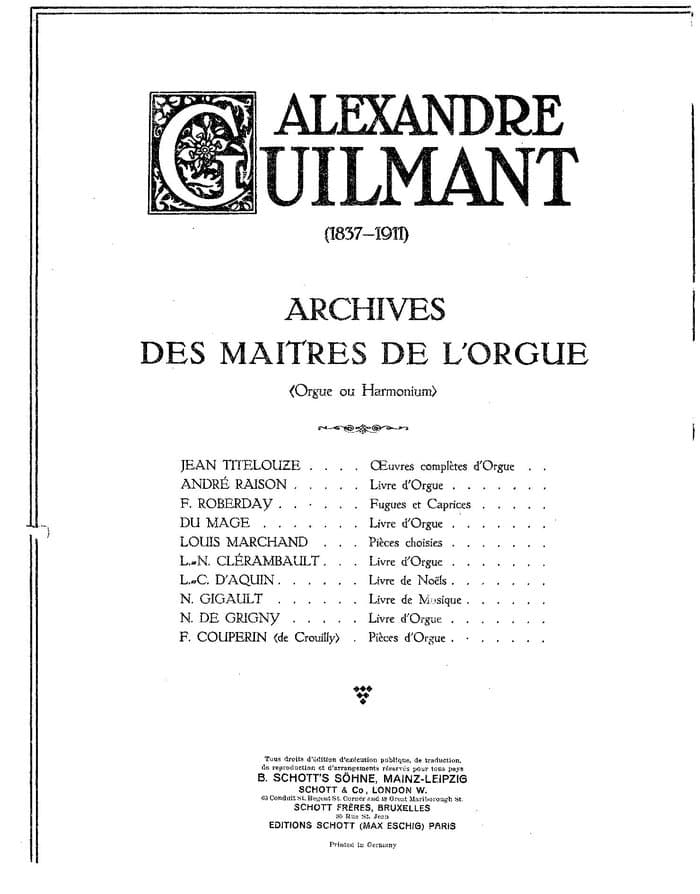
Archives des maîtres de l’orgue des XVIe, XVIIe et XVIIIe siècles (ed. Alexandre Guilmant and André Pirro), vol. 3: Clérambault, Premier livre d’orgue; Roberday, Fugues et caprices
Mainz, B. Schott’s Söhne, [1901-1914]
Copy: Ohio State University Libraries, via Internet Archive
Take part
This organ will be able to serve this music.