Baroque · French
Gaspard Corrette
around 1671 to 1732
French Classical
Core repertoire
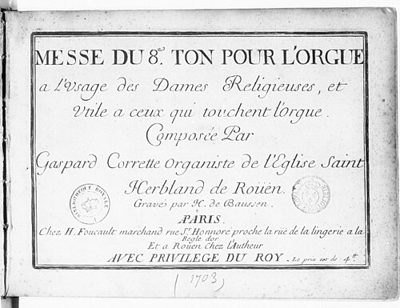
Image: BnF (Gallica btv1b9009986q), domaine public
Organist of the church of Saint-Herbland in Rouen before settling in Paris, Gaspard Corrette is the author of a "Messe du 8e ton" for organ (1703), his only surviving work. He should not be confused with his son Michel Corrette.
The repertoire
Works in the project’s repertoire
6 works, all available to listen to.
Core repertoire
This classification reflects the place of these repertoires within the artistic and educational orientations of the project. It does not constitute a technical indication regarding the design of the instrument.
Biography
Life and organ music
Gaspard Corrette was born around 1670 or 1671 and died before 1733. Organist of the church of Saint-Herbland in Rouen, he later settled in Paris, where his trail goes cold. His only surviving work, a Messe du 8e ton for organ published in 1703, is regarded as the last organ mass written in the great French tradition. He was the father of Michel Corrette, with whom he should not be confused.
Key dates
- c. 1670–1671
- Born, probably in Rouen
- 1700
- Marries Marguerite Thérèse Vérard in Rouen
- 1703
- Messe du 8e ton for organ, Paris
- 10 April 1707
- Birth of his son Michel in Rouen
- c. 1720
- Settles in Paris
- before 1733
- Death (before 1730 according to the BnF)
Rouen
Little is known of his life. He was the son of Jean Corrette, a dancing master, and Élisabeth Claire Québault, a couple recorded in Rouen in 1676. He was once thought to come from Delft, and the notice Musicologie.org devotes to his son still has him born there; the English and German Wikipedia articles say he was probably born in Rouen, while the French article leaves the question open. The Bibliothèque nationale de France places his birth in 1670 or 1671.
In Rouen he played the organ of the church of Saint-Herbland, which no longer exists. He was close to Jacques Boyvin, organist of the cathedral, for whom he sometimes deputised: Boyvin was a witness at his wedding, celebrated in Rouen in 1700, to Marguerite Thérèse Vérard. The couple had nine children, six daughters and three sons, among them Michel, born in Rouen on 10 April 1707. For Michel Rusquet, Gaspard Corrette was in Rouen the custodian of a great tradition, illustrated by Titelouze, Boyvin and d’Agincourt, and it was from him that his son learnt his craft.
The Messe du 8e ton
The Messe du 8e ton pour l’orgue à l’usage des Dames Religieuses, et utile à ceux qui touchent l’orgue was published in Paris in 1703. It contains twenty-four pieces, arranged according to the ordinary of the mass. The Kyrie opens with a grand plein jeu, followed by a fugue, a cromorne en taille, a trio à deux dessus and a dialogue à deux chœurs. The Gloria is the most extended: a prélude à deux chœurs, a concert pour les flûtes, a duo, a récit tendre pour le nasard, a dialogue de voix humaine, a basse de trompette ou de cromorne, a dessus de tierce par accords, a tierce en taille and a dialogue à deux chœurs. Then come a trio for the gradual, a grand dialogue à trois chœurs for the offertory, a plein jeu and a duo for the Sanctus, a cromorne en taille for the elevation, a plein jeu à deux chœurs and a dialogue en fugue for the Agnus Dei, and a grand plein jeu for the Deo gratias. A second gradual and a second elevation, on the fonds d’orgue, are offered as alternatives.
The encyclopaedia articles regard it as the last mass written in the great French tradition, that of Guillaume-Gabriel Nivers, François Couperin and Nicolas de Grigny. It circulated: eight of its pieces were carefully copied into the Livre d’orgue de Limoges. Several pieces from the mass are in the site’s repertoire.
Paris and the end
Michel left Rouen in 1720 to continue his training; the English and German articles also have Gaspard moving to Paris around 1720, while the French article says only that he settled there later. There his trail goes cold. The date of his death is not known. According to the French article, a note in his son’s marriage contract, dated 29 December 1732, shows that he was dead by then; Michel married Marie-Catherine Morize on 8 January 1733. The Bibliothèque nationale de France, for its part, records him as dead before 1730.
Sources
- Wikipedia (French), “Gaspard Corrette”, consulted November 2026
- Wikipedia (English), “Gaspard Corrette”, consulted November 2026
- Wikipedia (German), “Gaspard Corrette”, consulted November 2026
- Wikipedia (French), “Jacques Boyvin”, consulted November 2026
- Wikipedia (French), “Michel Corrette”, consulted November 2026
- Bibliothèque nationale de France, authority record “Corrette, Gaspard (1670?-17..)”
- Jean-Marc Warszawski, “Corrette Michel, 1707-1795”, Musicologie.org
- Michel Rusquet, “L’œuvre instrumentale de Michel Corrette”, Musicologie.org
Take part
This organ will be able to serve this music.