Baroque · French
Gilles Jullien
1651 to 1703
French Classical
Core repertoire
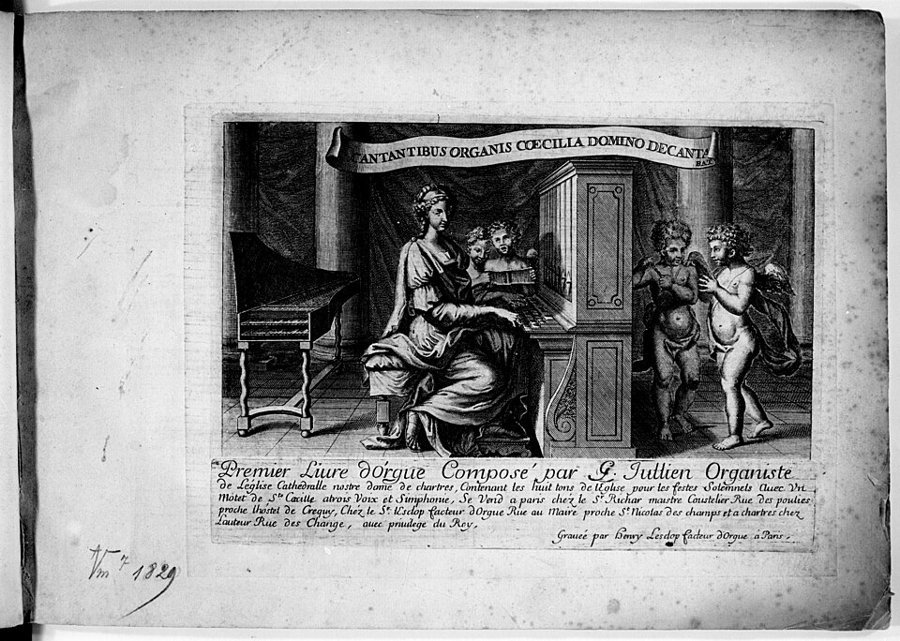
Image: BnF (Gallica btv1b9010325f), Wikimedia Commons, domaine public
Appointed organist of Chartres Cathedral at a very young age, Jullien held the post until his death. His Premier livre d’orgue (Paris, 1690) gathers pieces grouped by tone, one group for each of the eight church modes, clearly influenced by Lebègue.
The repertoire
Works in the project’s repertoire
2 works, all available to listen to.
Core repertoire
This classification reflects the place of these repertoires within the artistic and educational orientations of the project. It does not constitute a technical indication regarding the design of the instrument.
Biography
Life and organ music
Gilles Jullien was born in Paris between 1650 and 1653. Appointed organist of Chartres Cathedral at a very young age, he remained there until his death in 1703. His Premier livre d’orgue, published in 1690, is all that survives of his music; he is credited with bringing to Chartres the organ style then current in Paris.
Key dates
- between 1650 and 1653
- Born, in Paris according to the French article and the BnF
- 1668
- Organist of Chartres Cathedral (6 December 1667 according to the English article)
- 2 December 1690
- Privilege for the Premier livre d’orgue
- 14 September 1703
- Death in Chartres
- 27 July 1709
- His son and successor Jean-François is dismissed
The organist of Chartres
Almost nothing is known of his life or training. His burial record gives his age as fifty or slightly less: he was therefore born between 1650 and 1653, in Paris according to the French Wikipedia article and the BnF. He became organist of Notre-Dame de Chartres in 1668 according to the French article and the BnF; the English article gives 6 December 1667, a date it considers questionable, but it is certain that he was appointed very young. He kept the post until his death in Chartres on 14 September 1703. His eldest son, Jean-François, succeeded him and was dismissed on 27 July 1709.
The Premier livre d’orgue
The collection, engraved in Paris by Henry Lesclop, bears a privilege dated 2 December 1690. It is dedicated to the dean, canons and chapter of Chartres and announces that it contains “the eight church tones for solemn feasts, with a motet of St Cecilia for three voices and symphony”. Its eighty or so pieces fall into eight groups, one for each tone; they are often called suites, but the IMSLP editor points out that Jullien does not use the word and that the organist chose among the pieces in a given tone. The French article notes that he knew the works of Nivers, Lebègue and Gigault; the influence of Lebègue predominates.
A Parisian idiom
According to the preface these pieces are intended for the liturgy, but the only explicit link with plainchant is a fugue on Ave maris stella. There are four- and five-voice fugues and five-part preludes; Jullien claims to have invented these five-voice pieces, although Gigault, in 1685, and Raison had already published some. Critics have found his fugues and his chromatic writing rather crude and preferred his preludes and récits de dessus. The book ends, unusually, with a vocal piece, the St Cecilia motet for three voices, two treble parts and continuo, which the English article names Cantantibus organis.
Another vocal work, La Crèche de Bethléem, is known only by its title, and a second organ book, apparently planned, never appeared. Norbert Dufourcq republished the Premier livre in 1952.
Sources
- Wikipedia (French), “Gilles Jullien”, consulted November 2026
- Wikipedia (English), “Gilles Jullien”, consulted November 2026
- IMSLP, “Premier Livre d’Orgue (Jullien, Gilles)”, consulted November 2026
- Bibliothèque nationale de France, authority record “Jullien, Gilles (1650?-1703)”
- Charles Bouvet, Une dynastie de musiciens français : les Couperin, Paris, Delagrave, 1919, preface, p. vi (on Gigault’s preface) (Internet Archive)
Take part
This organ will be able to serve this music.