Baroque · French
Guillaume-Gabriel Nivers
around 1632 to 1714
French Classical
Core repertoire
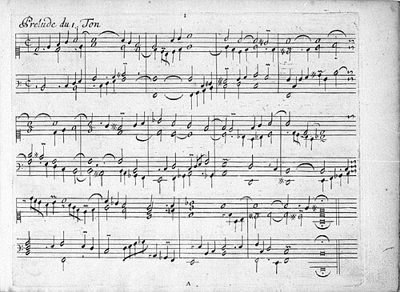
Image: BnF (Musique), domaine public
Organist to the king and master of music at the Royal House of Saint-Cyr, Nivers is a pioneer of the French classical organ school. His three organ books (1665, 1667, 1675) are among the earliest of their kind and lay the foundations of the French style.
Wikipedia Scores on IMSLP Report an error
Organ loftsChapelle royale, Saint-Sulpice
The repertoire
Works in the project’s repertoire
6 works, 4 of them available to listen to.
Core repertoire
Livre II - Livre d’orgue contenant la messe et les hymnes de l’Église (recueil)
Collection · Early edition
Core project repertoire
This classification reflects the place of these repertoires within the artistic and educational orientations of the project. It does not constitute a technical indication regarding the design of the instrument.
Biography
Life and organ music
Guillaume-Gabriel Nivers was born in Paris around 1632 and died there on 30 November 1714. Organist of Saint-Sulpice for half a century, organist to the King from 1678, master of music to the Queen and then to the Maison royale at Saint-Cyr, he published in 1665 the first organ book printed in France since those of Titelouze. His three books, together with Lebègue’s, established the forms of the French classical organ. A theorist and editor of plainchant, he was one of the agents of the liturgical renewal of his time.
Key dates
- c. 1632
- Born in Paris
- 1651–1653
- Organist of Saint-Sulpice (1654 according to Musicologie.org)
- 1665
- Livre d’orgue contenant cent pièces de tous les tons de l’Église
- 1667
- Second organ book and Traité de la composition
- 1675
- Troisième livre d’orgue des huit tons de l’Église
- 19 June 1678
- Organist to the King, July quarter
- 1686
- Master of music at the Maison royale, Saint-Cyr
- 30 November 1714
- Death in Paris (the 13th according to the English article)
Saint-Sulpice
He was the youngest child of Antoine Nivers, tax farmer to the Bishop of Paris, who died in 1635, and Geneviève Guignard. Shortly after 1643 the family left the parish of Saint-Paul for the Left Bank. His musical training is little known: the French Wikipedia article regards as hypothetical both a period among the choirboys of Saint-Sulpice and lessons with Chambonnières, whose influence on his works is nonetheless clear; the German article names Chambonnières as his teacher, and perhaps Henri Du Mont. He became a maître ès arts of the University of Paris in 1662 (in 1661 according to the German article).
He became organist of Saint-Sulpice, his parish church, between 1651 and 1653, probably succeeding Vincent Coppeau; Musicologie.org gives 1654. His salary, three hundred livres and later four and five hundred, including the blower’s wages, was more modest than that of other Parisian organists. According to the Wikipedia articles, he handed over the loft in 1702 to his nephew and pupil Jean-Baptiste Totin; Musicologie.org keeps him there until his death. He married Anne Esnault on 21 September 1668; she died in 1688. Their only son, Gabriel-Joseph, who joined the Lazarists, died in 1690, or 1691 according to the German article.
The three organ books
The Livre d’orgue contenant cent pièces de tous les tons de l’Église appeared in 1665, published by the author and Robert Ballard and engraved by Luders; it opens with Observations sur le toucher et jeu de l’orgue, dealing with fingering, ornaments, inequality and registration. The second book, in 1667, contains the mass and hymns of the Church; the third, in 1675, engraved by Gillet, the eight church tones. More than two hundred pieces in all, mostly short versets meant to alternate with the choir. The English article notes that the 1665 book is the earliest surviving printed collection in the forms of the French school, Louis Couperin having left only manuscripts.
Preludes, fugues and cantus firmus pieces preserve the counterpoint of the Church; duos, récits and dialogues come from the dance, the instrumental solo and the air. The German article sees in his versets à deux chœurs the origin of the dialogue. Nivers was also an organ expert: he was called in 1683 to approve the organ of Saint-Germain-l’Auxerrois, and in 1687 that of the chapel at Versailles.
In the King’s service
On 19 June 1678, after the death of Jacques Chabanceau de La Barre, he was appointed organist of the Chapel Royal by quarter, with Nicolas Lebègue, Jacques Thomelin and Jean-Baptiste Buterne; he had the July quarter. The sources disagree on the date of this division. The articles on Nivers and Lebègue place it in 1678; the article on the Chapelle royale dates it to 1693, after the arrival of François Couperin, with the same allocation: January for Couperin, April for Buterne, July for Nivers, October for Lebègue. Nivers resigned his post in 1708 in favour of Louis Marchand.
In 1681 he succeeded Henri Du Mont as master of music to the Queen, alternating with Paolo Lorenzani, until the death of Maria Theresa in 1683. That year he failed in the competition for the sous-maîtres of the Chapel Royal; he failed again, in 1696 according to the French article, in 1698 according to the German, at the Sainte-Chapelle, where Marc-Antoine Charpentier was chosen.
Saint-Cyr and plainchant
In 1686 he took charge of the music at the Maison royale de Saint-Louis at Saint-Cyr, founded for poor girls of noble birth, alongside Jean-Baptiste Moreau; he played the harpsichord there for Racine’s Esther and Athalie, despite disagreements with Madame de Maintenon. The French article has him in post until his death while dating Louis-Nicolas Clérambault’s arrival to 1704; the English article and Musicologie.org speak of a collaboration from about 1710.
Plainchant occupied him all his life. From 1658 he published graduals and antiphoners for Benedictine, Augustinian and Franciscan nuns, then for the Premonstratensians, Cluny and the Roman use; his Dissertation sur le chant grégorien of 1683 argues for a revision faithful to the ancient rules. His edition of the mass Cunctipotens genitor Deus served as the model for most French organ masses. His Traité de la composition de musique (1667) was translated into Dutch, and L’Art d’accompagner sur la basse continue (1689) is one of the first French texts on continuo.
He died on 30 November 1714, or the 13th according to the English article. The French article credits him with a fortune of two hundred thousand livres and land; the German article speaks of land and a library of two hundred thousand volumes, and says he was buried with the nuns of the Saint-Sacrement.
Sources
- Wikipedia (French), “Guillaume-Gabriel Nivers”, consulted November 2026
- Wikipedia (English), “Guillaume-Gabriel Nivers”, consulted November 2026
- Wikipedia (German), “Guillaume-Gabriel Nivers”, consulted November 2026
- Wikipedia (French), “Chapelle royale (Ancien Régime)”, consulted November 2026
- Jean-Marc Warszawski, “Nivers Guillaume-Gabriel, 1632-1714”, Musicologie.org
The sources
Digitised collections
Early editions and manuscripts containing works by this composer, digitised by libraries and available in full.
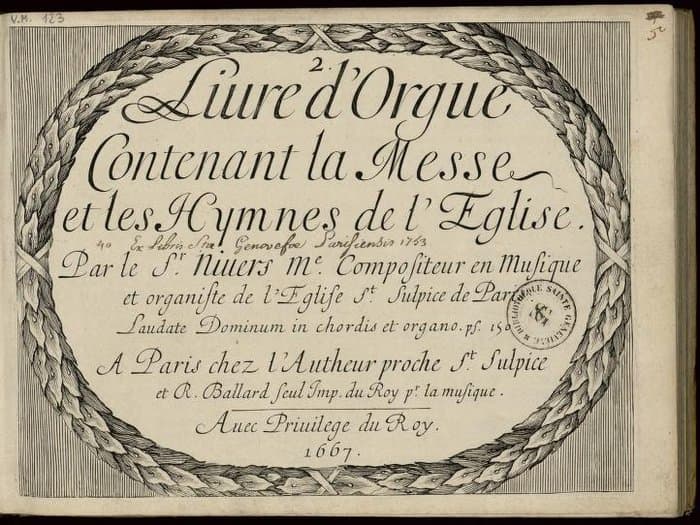
2. Livre d’orgue contenant la messe et les hymnes de l’Église
Paris, the author and Robert Ballard, 1667
Copy: Bibliothèque Sainte-Geneviève, via Internet Archive
Take part
This organ will be able to serve this music.