Classical · French
Guillaume Lasceux
1740 to 1831
French Classical
Core repertoire
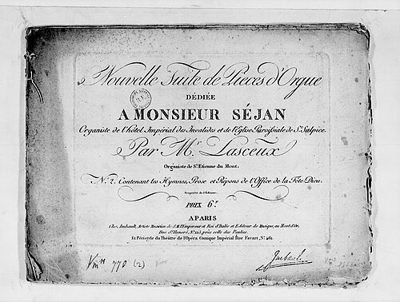
Image: BnF (Gallica btv1b10864404d), domaine public
Organist of Saint-Étienne-du-Mont in Paris, where he replaced Claude-Nicolas Ingrain from 1769 before becoming titular in 1774, Guillaume Lasceux retired in 1819 after living through the Revolution. A renowned virtuoso, he became famous for his improvisations on the Last Judgement. His Nouveaux Journaux de pièces d’orgue (1783-1785), with a mass, a Magnificat and noëls, and his Essai théorique et pratique sur l’art de l’orgue (1809) bear witness to French organ music at the turn of the 19th century.
The repertoire
Works in the project’s repertoire
6 works, 4 of them available to listen to.
Core repertoire
Flagship work
Essai théorique et pratique sur l’art de l’orgue (extraits)
Miscellaneous pieces
Unique document on French organ registrations at the turn of the 19th century
Flagship work
Messe pour orgue en sol majeur
Mass
Transition between Baroque and Classical, registrations remain in the tradition of the French Classical organ
Magnificat en fa majeur
Magnificat
Traditional liturgical forms in an evolved harmonic language, French Classical registrations
Messe pour orgue en ut majeur
Mass
Galant style applied to traditional French organ mass forms, classical registrations
Trois Noëls variés pour l’orgue
Noël
Typically French genre, varied registrations exploiting solo stops
This classification reflects the place of these repertoires within the artistic and educational orientations of the project. It does not constitute a technical indication regarding the design of the instrument.
Biography
Life and organ music
Guillaume Lasceux was born in Poissy on 3 February 1740 and died in Paris in 1831. Organist of Saint-Étienne-du-Mont for half a century, with the interruption of the Revolution, he held before 1789 several organ lofts in Parisian convents and colleges. His journals of organ pieces, from 1771 to the early 19th century, and his Essai théorique et pratique sur l’art de l’orgue of 1809 follow the French liturgical organ from the Ancien Régime to the Restoration.
Key dates
- 3 February 1740
- Born in Poissy
- 1758
- Organist of Saint-Martin, Chevreuse
- 1769
- Replaces Ingrain at Saint-Étienne-du-Mont (titular in 1774)
- 1771–1772
- Journal de pièces d’orgue
- c. 1782–1785
- Nouveau Journal de pièces d’orgue
- 1803
- Resumes his post at Saint-Étienne-du-Mont
- 1809
- Essai théorique et pratique sur l’art de l’orgue
- 28 May 1831
- Death in Paris (1829 according to Fétis)
From Chevreuse to Saint-Étienne-du-Mont
After his first musical studies in Poissy he became, in 1758, at the age of eighteen, organist of the parish of Saint-Martin in Chevreuse. In 1762 he settled in Paris and studied composition for five years with Charles Noblet, organist and harpsichordist of the Opéra; Fétis, who regarded Noblet as a “mediocre musician”, says only that he taught him what was then called composition in France.
In 1769 he replaced Claude-Nicolas Ingrain at the organ of Saint-Étienne-du-Mont, becoming its official titular in 1774; the authority record of the BnF gives him as organist of that church from 1774 to 1819. In the same year 1769, according to the Wikipedia article, he succeeded Noblet at the Mathurins and also played at the convent of Sainte-Aure; ten years later came the Minimes of the place Royale, the Collège de Navarre and the seminary of Saint-Magloire. Fétis gives a different chronology: appointed in 1769 to Saint-Étienne-du-Mont and Saint-Magloire, he succeeded Noblet at the Mathurins and the Collège de Navarre only later. In 1775 he was titular organist of the Mathurins when Jean-Jacques Beauvarlet-Charpentier came to examine the work of the builder Somer there; in 1777 Beauvarlet-Charpentier and Balbastre checked the enlargement carried out by Clicquot on the organ of Saint-Étienne-du-Mont.
The organ journals
His first collection is a Journal de pièces d’orgue issued in instalments in 1771 and 1772. The Wikipedia article calls it unpublished; the BnF, on the contrary, describes it as published in Paris by the author and by La Chevardière, and lists its contents: in 1771 eight Magnificats and four masses, in 1772 six Magnificats and six masses, a carillon for All Saints’ vespers and noëls. Some pieces state their use, “to serve as the 6th tone in religious communities and the 5th tone in parishes”, or “to serve for Mr Dumont’s mass in parishes”.
The Nouveau Journal de pièces d’orgue brings together a Messe des grands solennels, a Magnificat in F major and Trois noëls variés for organ or harpsichord. The Wikipedia article dates the first number to 1783 and the other two to 1785; the BnF places the first edition, published by Boyer, around 1782–1784. Fétis also mentions a Te Deum for organ published in 1785. At the same time Lasceux wrote sonatas for harpsichord or fortepiano, a piano quartet, romances and, around 1789, comic operas for the small theatres.
The Revolution and the return of worship
The Revolution cost him most of his posts. He earned his living accompanying the ceremonies of the Theophilanthropists at Saint-Étienne-du-Mont, renamed the “Temple of Filial Piety”. After the restoration of worship he resumed his post at Saint-Étienne-du-Mont in 1803. On St Cecilia’s day 1804 he had a solemn mass with orchestra performed at Saint-Gervais, according to Fétis. He was recognised as a virtuoso on the organ, the harpsichord and the fortepiano, and his improvisations on the Last Judgement made his reputation.
He then published a Nouvelle suite de pièces d’orgue in three numbers: a Messe des annuels et grands solennels, the hymns, proses and responsories for the office of Corpus Christi, and a Messe des solennels mineurs, now lost. The Wikipedia article dates it to 1812, the MUSEFREM database of the Centre de musique baroque de Versailles to 1806–1809. In it he addresses Nicolas Séjan, organist of Saint-Sulpice, whose “improvised masterpieces” would be for musicians “so many living lessons”.
The theorist and the last years
Dated 1809 and left in manuscript, the Essai théorique et pratique sur l’art de l’orgue contains twenty-six musical examples of every kind with their registrations. Fétis states that Lasceux submitted it in 1810 to the fourth class of the Institut and that the manuscript was, he believed, in the library of the Conservatoire. There followed in 1819 an Annuaire de l’organiste, “a work useful to those who intend to play the organ”, and in 1820 twelve fugues for organ. Fétis judged his compositions severely, as “badly written”, while acknowledging their success when they were new.
He retired from Saint-Étienne-du-Mont on 2 January 1819. According to Pierre-François Pinaud, quoted by MUSEFREM, he also taught the organ at the Institution for the Young Blind, where Jean-Nicolas Marrigues succeeded him in 1831. He died in Paris on 28 May 1831 according to the Wikipedia article and was buried two days later in Montparnasse cemetery. Fétis, who believed him still titular of Saint-Étienne-du-Mont at his death, places it in 1829.
Sources
- Wikipedia (French), “Guillaume Lasceux”, consulted November 2026
- Wikipedia (English), “Guillaume Lasceux”, consulted November 2026
- Bibliothèque nationale de France, authority record “Lasceux, Guillaume (1740-1831)”
- Bibliothèque nationale de France, work record “Journal de pièces d’orgue” (1771–1772)
- Bibliothèque nationale de France, work record “Nouveau journal de pièces d’orgue”
- François-Joseph Fétis, Biographie universelle des musiciens, 2nd ed., vol. V, Paris, Firmin-Didot, p. 205 (Internet Archive)
- Centre de musique baroque de Versailles, MUSEFREM database, entries “BEAUVARLET, Jean-Jacques, dit CHARPENTIER”, “SÉJAN, Nicolas, l’aîné” and “MARRIGUES, Jean-Baptiste-Nicolas”
Take part
This organ will be able to serve this music.