Classical · Flemish
Josse-François-Joseph Benaut
1741 to 1794
French Classical
Core repertoire
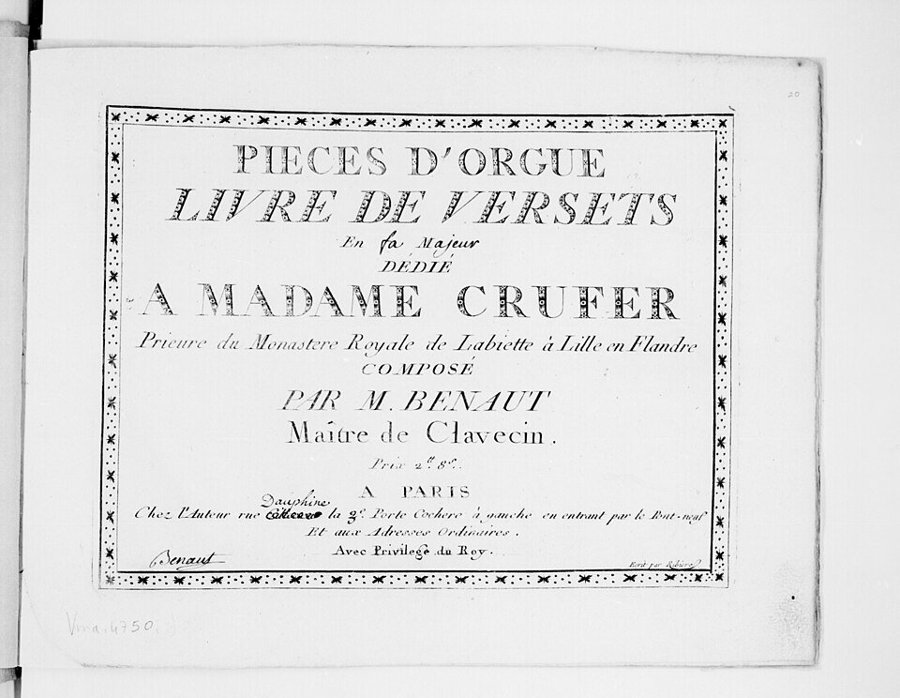
Image: BnF (Gallica btv1b10073712t), Wikimedia Commons, domaine public
Born in Gullegem in Flanders, the son of an organist, Josse-François-Joseph Benaut settled in Paris as a harpsichord teacher and, between 1772 and 1784, self-published more than two hundred and sixty collections. His organ music, written mainly for religious communities, includes at least twelve masses, six Magnificats and many noëls with variations. Having become a constitutional priest and parish priest of Saint-Cyr, he was guillotined in Paris on 13 July 1794.
The repertoire
Works in the project’s repertoire
7 works, 6 of them available to listen to.
Core repertoire
This classification reflects the place of these repertoires within the artistic and educational orientations of the project. It does not constitute a technical indication regarding the design of the instrument.
Biography
Life and organ music
Josse-François-Joseph Benaut was born in Gullegem, in Flanders, on 30 September 1741 and was guillotined in Paris on 13 July 1794. A harpsichord teacher settled in Paris, he published at his own expense, between 1772 and 1784, more than two hundred and sixty collections, largely arrangements of opera airs but also a substantial body of organ music intended for religious communities. Having become a priest and been elected constitutional parish priest of Saint-Cyr in 1791, he fell victim to the Terror.
Key dates
- 30 September 1741
- Born in Gullegem (c. 1743 according to other sources)
- 1771
- Marriage in Paris
- 1772
- Begins self-publishing his works
- 1776
- Mass and Magnificat on noëls with variations
- 1783
- Moves to the Hôtel de Soubise
- 1791
- Elected constitutional parish priest of Saint-Cyr
- 13 July 1794
- Guillotined in Paris
A Fleming in Paris
He was the son of Charles Benaut, organist at Wulveringen in Flanders. His date of birth varies between sources: the French Wikipedia article and the authority record of the BnF give 30 September 1741; the English article writes “c. 1743”, and the BnF records for his wife and daughter give his birth as 1743. He settled in Paris as a harpsichord teacher and in 1771 married the daughter of a merchant of Flemish origin, whom the BnF names as Aldegonde-Lucie-Perpétue De Buck, herself a composer and music engraver; it was she who engraved his first harpsichord book in 1773.
He made his career outside the court and the musical institutions, perhaps for lack of a place there. He sought the patronage of ladies of the nobility and the wealthy bourgeoisie, and above all of superiors of religious communities, without seeming to have found a true patron. He lived from his lessons and publications: he taught composition, harpsichord, fortepiano, and even dulcimer and psaltery, and offered “to compose expressly and supply in manuscript, for convents or the provinces, motets, organ pieces, masses, Magnificats, etc.”. He played the organ for the Dominican nuns of the Croix on great feasts and taught the harpsichord in several communities.
A prolific publisher
Between 1772 and 1784 he published more than two hundred and sixty works, of which some hundred and twenty survive. From 1776 he sold his collections by subscription. Most of them are arrangements of airs and overtures from the operas and opéras-comiques of the day, for harpsichord or fortepiano alone, with violin and cello ad libitum, or for two violins or flutes with bass. He adapted without partisanship the French, Italian and German successes of the Paris stage; the Wikipedia article counts him as the most prolific of the arrangers of his time, alongside Beauvarlet-Charpentier, Legat de Furcy or Tapray. His original keyboard music comprises a Premier livre de pièces de clavecin ou le forte-piano (1773), dedicated to the Princesse de Robeck, three sonatas with violin and sets of variations, always intended for both instruments.
The organ music
His organ music comprises at least twelve masses, six Magnificats, six hymns, thirteen books of versets, a book of noëls with variations, a Carillon for first vespers of the dead, an O filii et filiae with nine variations, a Te Deum laudamus with Judex crederis, and a few pieces left in manuscript. His printed catalogue distinguishes Pièces d’orgue for all kinds of offices, masses, hymns and Magnificats “in all keys”, and pieces “on Flemish, French and Italian noëls”. IMSLP thus holds a Mass in C major published by the author, probably in 1774, a Messe en noëls avec variations in F major dated October 1776 and a Magnificat en noëls in D minor of November 1776.
Benaut kept the old forms, fugue, voix humaine, fond d’orgue, cornet récit, and respected the liturgical framework, but he filled his books with musettes, bagpipes, tambourins, fanfares and hunting pieces. The Wikipedia article sees in this the influence of stage music and of the fashion for pastorals, and notes his knowledge of popular tunes from Normandy, Savoy, Provence, Flanders, Germany, Scotland or Poland. These pieces have been republished since 1996, notably the Mass in C minor and the Mass in F major.
The priest and the Terror
In 1783 he moved to the Hôtel de Soubise, probably under the protection of the Prince de Soubise, and thereafter published only a few collections. He may have taken holy orders at that time, in 1788 at the latest. His daughter Marie-Thérèse-Louise took over, publishing in 1787 and 1788, at the age of nine and ten, six collections of arrangements for harpsichord or fortepiano.
Having taken the oath to the Civil Constitution of the Clergy, he was elected parish priest of Saint-Cyr in 1791 and settled in the presbytery with his daughter, his instruments and his music books. The surveillance committee of Saint-Cyr denounced him to the district of Versailles, accusing him of “fanaticising the sick” of the hospital and of having “dealings with the rebels of the Vendée”. Arrested in November 1793, he appeared on 25 Messidor Year II, 13 July 1794, before the Revolutionary Tribunal and was guillotined the same day on the place du Trône-Renversé, now the place de la Nation; he was buried in the common grave at Picpus. His daughter, taken in by her godmother, died the following year, aged seventeen.
Sources
- Wikipedia (French), “Josse-François-Joseph Benaut”, consulted November 2026
- Wikipedia (English), “Josse-François-Joseph Benaut”, consulted November 2026
- Bibliothèque nationale de France, authority record “Benaut, Josse-François-Joseph (1741-1794)”
- Bibliothèque nationale de France, authority record of his wife, née Aldegonde-Lucie-Perpétue De Buck
- IMSLP, “Messe en noëls in F major (Benaut, Josse-François-Joseph)”
- IMSLP, “Mass in C major (Benaut, Josse-François-Joseph)”
Take part
This organ will be able to serve this music.