Classical · French
Jacques-Marie Beauvarlet-Charpentier
1766 to 1834
French Classical
Core repertoire
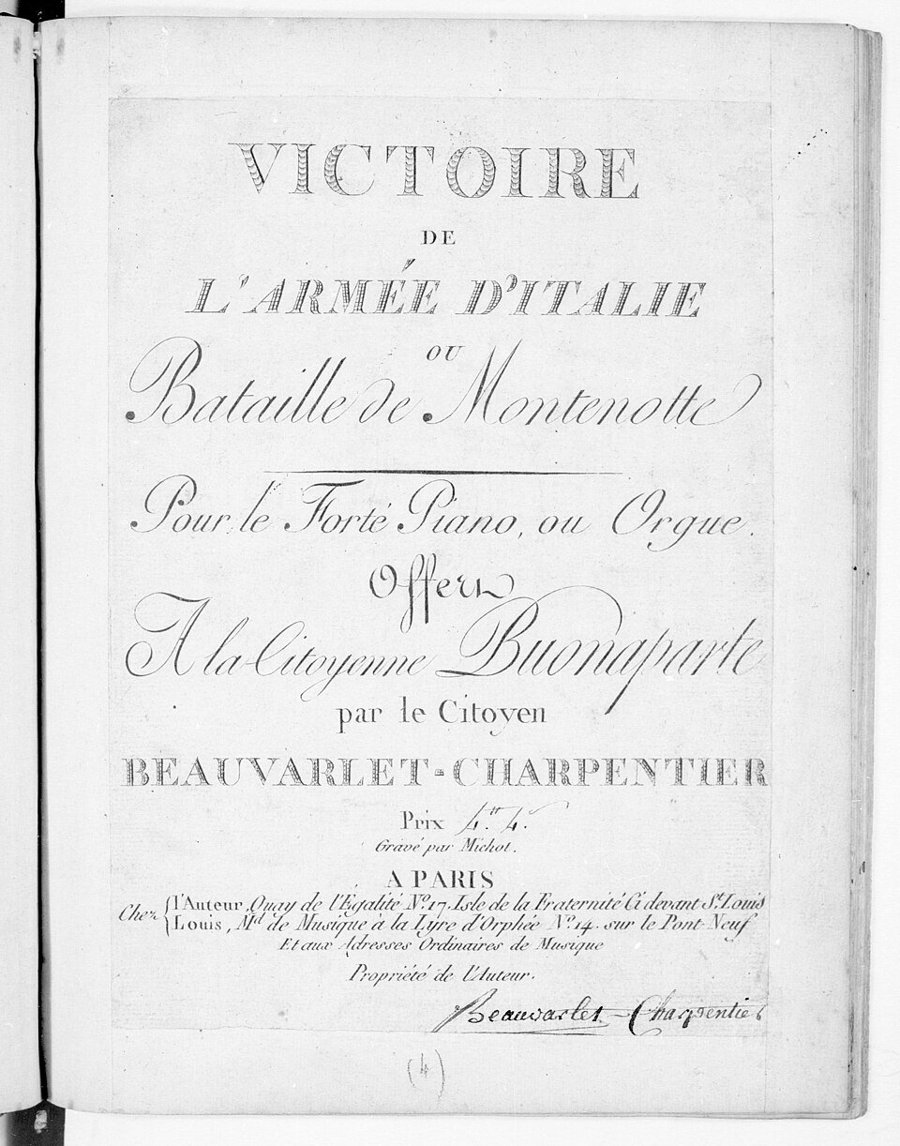
Image: BnF (Gallica btv1b90816909), Wikimedia Commons, domaine public
Born in Lyon, the son of Jean-Jacques Beauvarlet-Charpentier, Jacques-Marie succeeded his father at the organ of Saint-Paul in Paris after worship was restored, according to Fétis; he was also titular of Saint-Germain-des-Prés and, in 1815, of Saint-Eustache. He self-published liturgical collections — magnificats, hymns, masses, noëls — written for the organ and playable on the fortepiano, as well as a Journal d’orgue from 1822; his best-known piece is the Bataille de Montenotte.
The repertoire
Works in the project’s repertoire
5 works.
Core repertoire
Flagship work
Six Magnificats pour l’orgue, d’une exécution très facile sur le forte-piano
Magnificat
Core project repertoire
Quinze Noëls suivis de l’air « Où peut-on être mieux qu’au sein de sa famille », arrangés et variés pour l’orgue ou le piano
Noël
Core project repertoire
Six Hymnes des principales fêtes de l’année, avec fugues et autres versets, œuvre 8
Op. 8 · Hymn
Core project repertoire
Trois Messes pour les grandes solennités, composées pour l’orgue
Mass
Core project repertoire
Repertoire in dialogue
Victoire de l’armée d’Italie ou Bataille de Montenotte, pour le forte-piano ou orgue
Piece
Descriptive piece for fortepiano or organ
This classification reflects the place of these repertoires within the artistic and educational orientations of the project. It does not constitute a technical indication regarding the design of the instrument.
Biography
Life and organ music
Jacques-Marie Beauvarlet-Charpentier was born in Lyon in July 1766 and died in Paris in 1834. Son and pupil of Jean-Jacques Beauvarlet-Charpentier, he deputised for him at Saint-Paul before the Revolution, came through the revolutionary years publishing battle pieces for the fortepiano, and returned to the organ loft once worship was restored: Saint-Paul, Saint-Germain-des-Prés, Saint-Eustache. His collections for the liturgy, published at his own address, are written for the organ but advertised as playable on the fortepiano.
Key dates
- 3 July 1766
- Born in Lyon (31 July according to Wikipedia)
- 1788
- Deputises for his father at Saint-Paul
- 1796
- Bataille de Montenotte, for fortepiano or organ
- 1815
- Organist of Saint-Eustache, according to Wikipedia
- 1822
- First issue of his Journal d’orgue
- 7 September 1834
- Death in Paris (in November according to Fétis)
The son of a famous organist
He was born in Lyon to Jean-Jacques Beauvarlet-Charpentier, then organist of the hospice de la Charité, and the singer Marie Bérol. His date of birth varies: 3 July 1766 for the authority record of the BnF and for Fétis, and the MUSEFREM database of the Centre de musique baroque de Versailles quotes the baptismal record, dated the following day at Saint-Nizier, which says he was “born on the 3rd”; the Wikipedia article gives 31 July. He was five when the family moved to Paris, where his father became organist of Saint-Victor and Saint-Paul. According to Fétis, his father taught him harpsichord and composition.
In 1788 he deputised for his father at Saint-Paul. In September 1794, a few months after his father’s death, an artist obtained permission for Desprez, Séjan, “Charpentier fils” and other well-known organists to play the organ of the former cathedral of Notre-Dame, which the ban on playing was leaving to deteriorate.
Battles and succession
His best-known piece dates from these years: Victoire de l’armée d’Italie ou Bataille de Montenotte, for fortepiano or organ, offered “to citizeness Buonaparte”. The BnF dates it to 1796 from an advertisement of 12 September that year; the Wikipedia article places it around 1797. Fétis also lists a Bataille d’Austerlitz (1805), a Bataille d’Iéna (1807) and a one-act opera, Génois ou le Jeune Aveugle, given in 1802 at the Théâtre des Jeunes Artistes.
The sources disagree about his first posts. Fétis writes that he succeeded his father as organist of Saint-Paul “after the churches were re-established”, that is, in Paris. The Wikipedia article has him succeed his father at Saint-Paul in Lyon; no other source consulted mentions such a post in Lyon, and his father had left the city in 1771. After the Revolution he became titular of Saint-Germain-des-Prés and then, in 1815, of Saint-Eustache, according to the Wikipedia article; the list of organists of Saint-Eustache names him, without dates. Fétis, by contrast, calls him organist of Saint-Germain-des-Prés in the last years of his life.
The liturgical collections
Most of his organ pieces were published at his own address, without date. The Six Magnificats pour l’orgue, “very easy to perform on the fortepiano”, are dedicated to the clergy of the French Empire. The Trois Messes pour les grandes solennités are based on Henry Du Mont’s plainchant and each ends with a Domine salvum fac regem. The Six Hymnes des principales fêtes de l’année, avec fugues et autres versets, Op. 8, are preceded by the Easter sequence and followed by the Inviolata, the Ave verum and a Carillon des morts, as in his father’s work. The Quinze Noëls, varied for organ or piano, end with Grétry’s air “Où peut-on être mieux qu’au sein de sa famille”.
The Wikipedia article also mentions two Te Deums, organ masses and a Journal d’orgue published from 1822; Fétis mentions a Méthode d’orgue followed by the complete Sunday office and a Te Deum for solemn feasts. He also published romances, contredanses and varied airs, such as those of La Soirée amusante, around 1810. He died in Paris in 1834, on 7 September according to the BnF and the Wikipedia article, in November according to Fétis.
Sources
- Bibliothèque nationale de France, authority record “Beauvarlet-Charpentier, Jacques-Marie (1766-1834)”
- François-Joseph Fétis, Biographie universelle des musiciens, 2nd ed., vol. I, Paris, Firmin-Didot, p. 287 (Internet Archive)
- Centre de musique baroque de Versailles, MUSEFREM database, entry “BEAUVARLET, Jean-Jacques, dit CHARPENTIER, le père” (birth of the son), and entry “SÉJAN, Nicolas, l’aîné” (1794)
- Wikipedia (French), “Jacques-Marie Beauvarlet-Charpentier”, consulted November 2026
- Wikipedia (French), “Jean-Jacques Beauvarlet-Charpentier”, consulted November 2026
- Wikipedia (French), “Grand orgue de l’église Saint-Eustache”, list of organists, consulted November 2026
- Bibliothèque nationale de France, general catalogue, “Victoire de l’armée d’Italie ou Bataille de Montenotte”
- Bibliothèque nationale de France, general catalogue, “Six Hymnes des principales fêtes de l’année… Oeuvre 8”
Take part
This organ will be able to serve this music.