Classical · French
Gervais-François Couperin
1759 to 1826
French Classical
Core repertoire
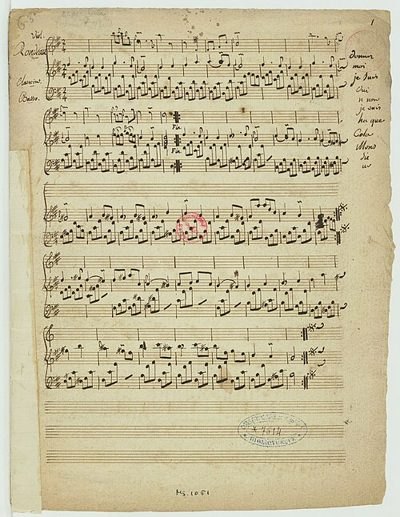
Image: BnF (Gallica btv1b10020204t), domaine public
Son and pupil of Armand-Louis and the last male representative of the Couperin dynasty, Gervais-François replaced his father at the Sainte-Chapelle in 1789 and in the same year succeeded his brother Pierre-Louis at Saint-Gervais; he was also organist of Saint-Merri. In 1794, at the opening of the Opéra under the name Théâtre des Arts, he and Nicolas Séjan played patriotic airs on two organs placed on either side of the proscenium. His daughter Céleste-Thérèse briefly succeeded him at Saint-Gervais, a post held by the family since 1653.
Wikipedia Scores on IMSLP In the Couperin family tree Report an error
Organ loftsSaint-Gervais-Saint-Protais, Saint-Merry
The repertoire
Works in the project’s repertoire
9 works, 7 of them available to listen to.
Core repertoire
This classification reflects the place of these repertoires within the artistic and educational orientations of the project. It does not constitute a technical indication regarding the design of the instrument.
Biography
Life and organ music
Gervais-François Couperin was born in Paris on 22 May 1759 and baptised the same day at Saint-Gervais, where his father Armand-Louis was organist. The last child of his parents, he signed himself “Couperin le jeune”. An organist through the Revolution, the Empire and the Restoration, he was the last man of the dynasty to hold the organ loft of Saint-Gervais; after him, his daughter Céleste-Thérèse kept it for only a few months.
Key dates
- 22 May 1759
- Born and baptised in Paris, parish of Saint-Gervais
- 1782
- A first rondo published in the Journal de clavecin
- 1789
- Sainte-Chapelle, then Saint-Gervais on his brother’s death (date debated)
- 1790
- Variations on Ah! ça ira
- 6 November 1799
- Plays the organ of Saint-Sulpice at the banquet for Bonaparte
- 1818
- Start of the post at Saint-Merry, or at Saint-Gervais, according to the reference works
- 11 March 1826
- Death in Paris
The year 1789
He was taught by his father and by his mother, Élisabeth-Antoinette Blanchet, herself an organist. At eighteen he had a symphony of his own performed at private concerts, according to Choron and Fayolle, quoted by Bouvet; a rondo of his appeared in 1782 in the publisher Leduc’s Journal de clavecin.
The year 1789 decided his career. His father died on 2 February; the burial record already describes him as organist of the Sainte-Chapelle, where he took his father’s place. His elder brother Pierre-Louis, for whom their father had sought the survivance of Saint-Gervais in 1773, died in turn on 10 October. Gervais-François succeeded him at Saint-Gervais and, according to Bouvet, in all his posts; the press announced that on 15 November 1789, for the feast of Providence, “M. Couperin, organist of this church, will play the organ throughout the service”.
The date on which he took up the post at Saint-Gervais is nevertheless debated. The church council’s accounts for 1790, published by Bouvet, show him being paid for the quarters following his brother’s death, and Bouvet credits him with thirty-seven years of service. The MUSEFREM database of the Centre de musique baroque de Versailles, which reconstructs careers from archival records, likewise has him at this organ from October 1789. The Wikipedia article on the church, on the contrary, makes him titular organist from 1818 to 1826, dates which his own articles place after Saint-Gervais and Saint-Merry without saying to which church they apply. These articles also have him succeed his brother at Notre-Dame, whereas the list of organists of the cathedral does not mention him; according to MUSEFREM, the chapter appointed the organist Philippe-Antoine Desprez in Pierre-Louis’s place, and the four organists of Notre-Dame in 1790 were Beauvarlet-Charpentier, Desprez, Séjan and Balbastre.
Under the Revolution and the Empire
A title page of 1790 describes him as “organist to the King, of St Gervais, St Jean, Ste Marguerite and the Carmes Billettes”. He then published variations on Ah! ça ira and, under the Directory, Les Incroyables and Les Merveilleuses. At the opening of the Opéra under the name Théâtre des Arts, he and Nicolas Séjan played patriotic airs with variations as duets, on two organs placed on either side of the proscenium. Bouvet dates the event to 1793; the issue of the Affiches he quotes is dated Thermidor of Year II.
On 6 November 1799 he played the organ of Saint-Sulpice, then the Temple of Victory, during the banquet given for General Bonaparte. With Séjan, Miroir, Desprès and Blin, he played the organ of Saint-Merry, rebuilt by the organ builder Clicquot, at its acceptance. According to MUSEFREM, Joseph Pouteau, who succeeded Desprez at Saint-Merry in 1804, shared the organist’s duties there with him. In July 1810 a chronicler reported that at the Te Deum for the feast of Saint-Gervais his imitations of the human voice and his thunder effects drew applause from the congregation inside the church.
This taste for effect earned him conflicting judgements. Fétis considered him “a mediocre organist”; Bouvet, who reports the public’s enthusiasm, rejects this verdict, while regretting that he adapted his style to his listeners’ taste. Boëly, who had known him, thought him daring in his modulations.
The works and the end of a dynasty
His engraved works number about a dozen opus numbers: sonatas for harpsichord or pianoforte, romances, variations, an occasional piece for the return of Louis XVIII in 1816. For the organ he left many liturgical pieces: offertories, Gloria versets, récits and duos.
In 1792 he married a singer, his pupil Hélène Frey, whose first name and surname vary between sources. Their only daughter, Céleste-Thérèse, was born in 1793, or in 1792 according to the article on the church. Gervais-François died in Paris on 11 March 1826, according to the Bibliothèque nationale de France and recent reference works; Bouvet, who did not know this date, placed it in June on the strength of the church council’s registers. Céleste-Thérèse replaced him for a few months, then Jean-Nicolas Marrigues was appointed. After more than a hundred and seventy years, the organ loft of Saint-Gervais passed out of the Couperin family.
Sources
- Wikipedia (French), “Gervais-François Couperin”, consulted November 2026
- Wikipedia (English), “Gervais-François Couperin”, consulted November 2026
- Centre de musique baroque de Versailles, MUSEFREM database, entry “COUPERIN, Gervais François (1759-1826)”, updated 26 June 2025, and page “Paris - Notre-Dame”
- Charles Bouvet, Une dynastie de musiciens français : les Couperin, organistes de l’église Saint-Gervais, Paris, Delagrave, 1919 (Internet Archive)
- Bibliothèque nationale de France, authority record “Couperin, Gervais-François (1759-1826)”
- Wikipedia (French), “Église Saint-Gervais-Saint-Protais de Paris”, consulted November 2026
- Wikipedia (French), “Céleste-Thérèse Couperin”, consulted November 2026
- Wikipedia (French), “Grand orgue de Notre-Dame de Paris”, list of organists, consulted November 2026
Take part
This organ will be able to serve this music.