Classical · French
Jean-Jacques Beauvarlet-Charpentier
1734 to 1794
French Classical
Core repertoire
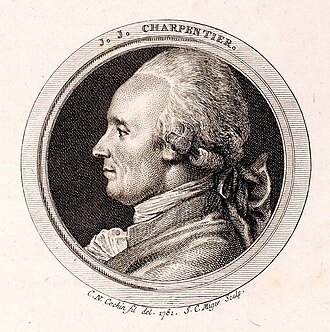
Born in Abbeville and trained in Lyon, Jean-Jacques Beauvarlet-Charpentier settled in Paris in 1771; organist of the abbey of Saint-Victor (after a competition in June 1772 according to the MUSEFREM database, from 1771 according to other sources), he succeeded Daquin at Saint-Paul in 1772 and served as quarterly organist of Notre-Dame from 1783 to 1793. His "Journal d’orgue à l’usage des paroisses et communautés religieuses" (1784-1785) gathers masses, magnificats, hymns and noël variations.
Wikipedia Scores on IMSLP Report an error
Organ loftsNotre-Dame Cathedral
The repertoire
Works in the project’s repertoire
5 works, 4 of them available to listen to.
Core repertoire
Flagship work
Douze Noëls variés pour l’orgue, avec un Carillon des morts
Op. 13 · Noël
Core project repertoire
This classification reflects the place of these repertoires within the artistic and educational orientations of the project. It does not constitute a technical indication regarding the design of the instrument.
Biography
Life and organ music
Jean-Jacques Beauvarlet-Charpentier was born in Abbeville on 28 June 1734 and died in Paris on 6 May 1794. Trained in Lyon by his father, an organist and builder, he made his name there as a virtuoso before moving to Paris in 1771, where he held the abbey of Saint-Victor, the parish of Saint-Paul and, from 1783, a quarter at Notre-Dame. His Journal d’orgue of 1784–1785 is one of the major liturgical collections of the end of the Ancien Régime. He was the father of the organist Jacques-Marie Beauvarlet-Charpentier.
Key dates
- 28 June 1734
- Born in Abbeville
- 7 January 1763
- Succeeds his father at the hospice de la Charité, Lyon
- 3 July 1766
- Birth of his son Jacques-Marie
- 1771–1772
- Organist of Saint-Victor and Saint-Paul in Paris
- 15 May 1781
- Examines Clicquot’s organ at Saint-Sulpice
- 20 October 1783
- Quarterly organist of Notre-Dame
- 1784–1785
- Journal d’orgue à l’usage des paroisses et communautés religieuses
- 6 May 1794
- Death in Paris
From Abbeville to Lyon
He was baptised on 29 June 1734 at Sainte-Catherine in Abbeville. His father, Jean-Baptiste Beauvarlet known as Charpentier, was a dyer and merchant, but also an organist and organ builder; the exact origin of the nickname, which the son also bore, is unknown. The family settled in Lyon, around 1739 according to the MUSEFREM database of the Centre de musique baroque de Versailles, around 1748 according to the Wikipedia article. There the father worked as a builder of organs and harpsichords and became organist of the hospice de la Charité; Jean-Jacques probably completed his training there and regularly deputised for him.
On 15 August 1759 he played a concerto of his own at the Concert spirituel in Paris. In 1761 he became organist of the Concert of the Académie des beaux-arts in Lyon, where he also appeared as soloist. When his father died on 7 January 1763 he succeeded him at the Charité, at 120 livres a year. On 20 June 1763 he married the singer Marie Bérol; their son Jacques-Marie was born in Lyon on 3 July 1766. He published a first book of harpsichord pieces and collections of ariettes, and played organ concertos at the Concert, among them a Christmas concerto. An anecdote reported in 1834 has Jean-Jacques Rousseau, hearing him in Lyon in 1771, judging that he had “too much talent” to stay there.
Saint-Victor, Saint-Paul and Notre-Dame
He moved to Paris in 1771, where the Archbishop of Lyon, who was abbot of Saint-Victor, had undertaken to find him a post. The Wikipedia article and Fétis make him organist of the abbey of Saint-Victor from 1771; MUSEFREM dates to June 1772 the competition, judged by Daquin and Balbastre, that gave him this loft. That same year, after another competition, he succeeded Louis-Claude Daquin at the parish of Saint-Paul, which he held until 1793. On 20 October 1783, after the death of Claude-Étienne Luce, he became one of the four quarterly organists of Notre-Dame, until worship was suppressed in 1793. In 1788 his son deputised for him at Saint-Paul.
He was often called upon to examine organs: with Armand-Louis Couperin and Balbastre at the English Benedictines (1773), with Clicquot at Nogent-sur-Marne (1775), with Lasceux at the Mathurins (1775), with Balbastre at Saint-Étienne-du-Mont (1777), with Couperin and Séjan at Saint-Roch (1778). On 15 and 16 May 1781 he was one of the four organists, with Couperin, Balbastre and Nicolas Séjan, who received Clicquot’s great organ at Saint-Sulpice. In 1788 he was among the organists of Notre-Dame charged with examining Clicquot’s work on the cathedral organ.
The organ works
Alongside a large output for harpsichord and fortepiano, sonatas with violin, concertos and above all varied opera airs, his organ music appeared from 1777: Six fugues pour l’orgue ou le clavecin (Op. 6), reissued around 1784, and Trois Magnificat (Op. 7). In 1782 came the Douze Noëls variés pour l’orgue, avec un Carillon des morts qui se joue le jour de la Toussaint après le Magnificat (Op. 13), dedicated to the Countess of Arundell; the Wikipedia article adds a Mass in G minor (Op. 15), around 1782.
The Journal d’orgue à l’usage des paroisses et communautés religieuses appeared in twelve instalments between June 1784 and March 1785: masses in E minor, D minor and G minor, Du Mont’s Messe royale, six fugues, several Magnificats, two of them with noël variations, hymns and proses for the great feasts, a Carillon des morts for the Gloria Patri of the All Saints’ Magnificat and four Grands Chœurs for the return of processions. Fétis dates this Journal to 1790, published by Le Duc. MUSEFREM reports the view of Jean-Luc Perrot that Beauvarlet-Charpentier gave the organ journal its prestige. Fétis, by contrast, judged that his works did not justify his reputation.
The end
In 1793 he published his version of the Marche des Marseillois in the Feuilles de Terpsichore and signed, with Balbastre, Gervais-François Couperin and Séjan, a testimonial for Claude Hermant de Saint-Benoist’s Nouvel hymnaire parisien. That same year the closing of the churches cost him his posts. According to Choron, quoted in the Wikipedia article, his forced departure from Saint-Paul and Saint-Victor and the destruction of the organs “caused him an extremely deep sorrow; his health declined rapidly”. He died on 6 May 1794 in a flat in the rue Gervais, at nearly sixty. Fétis had him born in 1730; the BnF, MUSEFREM and Wikipedia give 28 June 1734. He was a first cousin of the engraver Jacques-Firmin Beauvarlet.
Sources
- Centre de musique baroque de Versailles, MUSEFREM database, entry “BEAUVARLET, Jean-Jacques, dit CHARPENTIER, le père”, updated 26 October 2021
- François-Joseph Fétis, Biographie universelle des musiciens, 2nd ed., vol. I, Paris, Firmin-Didot, p. 287 (Internet Archive)
- Bibliothèque nationale de France, authority record “Beauvarlet-Charpentier, Jean-Jacques (1734-1794)”
- Wikipedia (French), “Jean-Jacques Beauvarlet-Charpentier”, consulted November 2026
- Wikipedia (English), “Jean-Jacques Beauvarlet-Charpentier”, consulted November 2026
- Wikipedia (French), “Grand orgue de Notre-Dame de Paris”, list of organists, consulted November 2026
Take part
This organ will be able to serve this music.