Baroque · French
Jean Titelouze
around 1563 to 1633
Early French Classical
Core repertoire
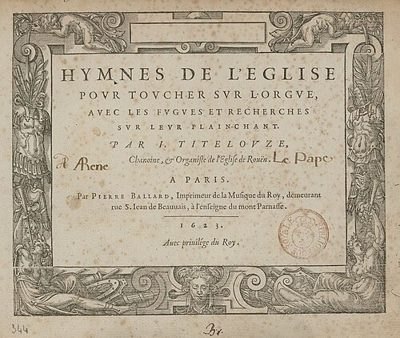
Image: BnF (Gallica), domaine public
Organist of Rouen Cathedral, Jean Titelouze is considered the founding father of the French organ school. His "Hymnes de l’Église" (1623) and "Le Magnificat" (1626) are the first organ collections published in France since those of Attaingnant (1530-1531).
« C’est surtout dans l’emploi des dissonnances contenues dans l’échelle naturelle des modes que sa hardiesse se dénonce le plus heureusement : par exemple, l’usage des septièmes donne parfois à ses modulations un caractère tout à fait moderne. »
English translation: “It is above all in the use of the dissonances contained in the natural scale of the modes that his boldness shows itself to best advantage: the use of sevenths, for instance, sometimes gives his modulations a thoroughly modern character.”
The repertoire
Works in the project’s repertoire
23 works, 7 of them available to listen to.
Core repertoire
Flagship work
Hymne Ave Maris Stella
Hymn · Early edition
Style to interpret according to the character of the work
This classification reflects the place of these repertoires within the artistic and educational orientations of the project. It does not constitute a technical indication regarding the design of the instrument.
Biography
Life and organ music
Jehan Titelouze was born in Saint-Omer around 1563, into a family of town musicians. A priest, organist of Rouen Cathedral for forty-five years, canon, prize-winning poet at the Palinods and correspondent of Father Mersenne, he published in 1623 and 1626 the first organ collections printed in France since those of Attaingnant, nearly a century earlier. He is regarded as the founder of the French organ school.
Key dates
- c. 1563
- Born in Saint-Omer
- 1585
- Organist of Saint-Jean, Rouen
- 1588
- Organist of Rouen Cathedral
- 2 April 1610
- Canon of the cathedral
- 1613
- First prize at the Rouen Palinods (1615 according to Pirro)
- 1623
- Hymnes de l’Église pour toucher sur l’orgue
- 1626
- Le Magnificat suivant les huit tons de l’Église
- 24 October 1633
- Death in Rouen (the 25th according to Pirro)
From Saint-Omer to Rouen
Saint-Omer then belonged to the Spanish Netherlands. The Titelouze family is recorded there from the late 15th century; Jehan was the son of Benoît, watchman and musician of the town. The documents say nothing of his training: the German Wikipedia article has him trained in Saint-Omer and Douai, while the French article stresses that sources are lacking. He himself reminded Mersenne, in 1624, that he had been concerned with the modes for more than forty years. He was a priest and, in 1585, one of the deputy organists of Saint-Omer Cathedral; the English article calls him organist of that cathedral.
That same year he was engaged at the church of Saint-Jean in Rouen. On 13 April 1588 François Josseline, organist of the cathedral for twenty-three years, died. The post was opened to competition; according to André Pirro, who wrote the notice in the Archives des maîtres de l’orgue in 1898, Titelouze won it through his gift for improvisation against several rivals, among them the priest Toussaint Lefebvre, who had been deputising. Pirro dates his election to 12 April, the French article to two days after Josseline’s death. He kept Saint-Jean until 1589. Letters of naturalisation were granted to him in 1595 and registered in 1604.
The canon and expert
His salary rose from thirty écus in 1590 to a hundred and twenty livres in 1599. On 2 April 1610 he was made a canon, with the prebend of Baillolet, and that same year received the living of Londinières. Priest, canon and organist of his cathedral, he also looked after the choirboys of the maîtrise.
His reputation soon spread beyond Rouen. As early as 1588 he examined the organ of Notre-Dame-de-la-Ronde, repaired by Nicolas Barbier; in 1597 he drew up an estimate for the organ of Saint-Michel and chose the builder Crespin Carlier to repair it, in 1602 according to the French article, in 1603 according to Pirro. He was to work often with Carlier; according to the English article, he brought him to the cathedral as early as 1600, and its organ was then considered the best in France. He was consulted for Saint-Denis around 1604, Poitiers in 1613, Amiens in 1623 and Eu in 1628–1629. As late as 1632 he drew up the estimate for the organ of Saint-Godard, in which he is described as “one of the most skilful organists in France”. The French article credits him with influence on Norman builders, in favour of an organ with two manuals and a full pedalboard, Flemish in its stoplist but already pointing towards the French classical organ.
Poet and scholar
Titelouze twice won the prize at the Puy des Palinods in Rouen, a poetry competition in honour of the Immaculate Conception. His chant royal on the organ has as its refrain “D’un sourd métail une grande harmonie” (“From a mute metal, a great harmony”); the French article dates it to 1613, Pirro to 1615, the year it was printed. The second, in 1630, celebrates numerical proportions. Elected prince of the Palinods for 1633, he died before taking up the office; the English article places this election in 1630.
He corresponded with Father Marin Mersenne: seven of his letters, written between 1622 and 1633, deal with the modes, intervals, temperament and notation. In them he rejects the chromatic genus, since “a single chromatic interval, even mixed into the diatonic, is barely tolerable”, and leaves theory to the scholar: “I write nothing on theory; I leave the pen to you”. Mersenne reports in his Harmonie universelle that Titelouze had divided the tone into three equal parts on a special spinet.
The two organ books
All his known work was published by Pierre Ballard between 1623 and 1626, when he was past sixty. The Hymnes de l’Église pour toucher sur l’orgue, avec les fugues et recherches sur leur plain-chant (1623, some copies dated 1624) set twelve hymns in three or four versets each: the plainchant is held in long notes, usually in the bass, or becomes the subject of fugues, and some versets are canonic. Le Magnificat, ou cantique de la Vierge, suivant les huit tons de l’Église (1626) gives seven versets for each tone, nearly all of them fugal. The prefaces express his wish for music playable by the hands alone, which the organist could shorten during the service. In 1626 Ballard also printed four vocal masses, rediscovered in 2016.
This modal, contrapuntal writing, inherited from vocal polyphony, was soon abandoned by French organists, who came to prefer the colours of solo stops. Yet his name remained attached to a style: in 1685 Nicolas Gigault still wrote versets “fugued in the manner of the late Monsieur Titelouze”. Pirro, in 1898, praised the boldness of his sevenths; Marcel Dupré, born in Rouen, paid tribute to him in 1942 with Le Tombeau de Titelouze.
The end
On 21 January 1633, weakened, he asked the chapter for the means to train a young organist to stand in for him. He died on 24 October 1633, according to the register of the parish of Saint-Nicolas; Pirro gave the 25th, the day on which he was buried in the cathedral, near the altar of St Cecilia. He left his organ to the builder Guillaume Lesselier and his music to his nephew Blaise Bretel, organist of Saint-Vincent.
Sources
- André Pirro, notice “Jean Titelouze”, Archives des maîtres de l’orgue, vol. I, Paris, 1898, pp. vii–xv (Internet Archive)
- Wikipedia (French), “Jehan Titelouze”, consulted November 2026
- Wikipedia (English), “Jean Titelouze”, consulted November 2026
- Wikipedia (German), “Jean Titelouze”, consulted November 2026
- Bibliothèque nationale de France, authority record “Titelouze, Jehan (1563-1633)”
The sources
Digitised collections
Early editions and manuscripts containing works by this composer, digitised by libraries and available in full.
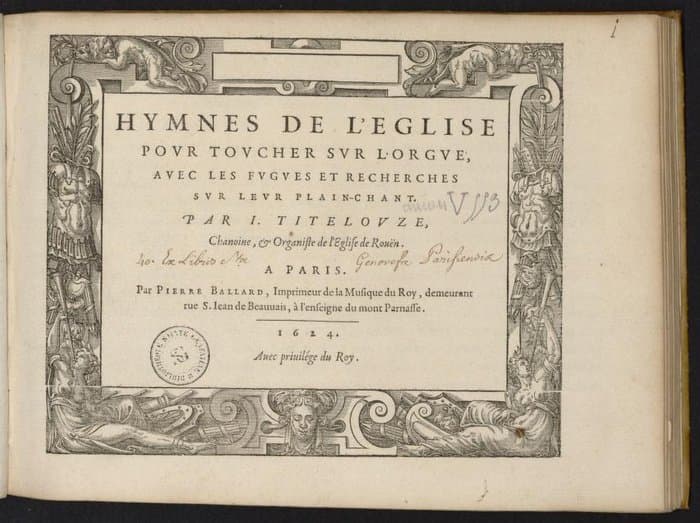
Hymnes de l’Église pour toucher sur l’orgue, avec les fugues et recherches sur leur plain-chant
Paris, Pierre Ballard, 1624
Copy: Bibliothèque Sainte-Geneviève, via Internet Archive
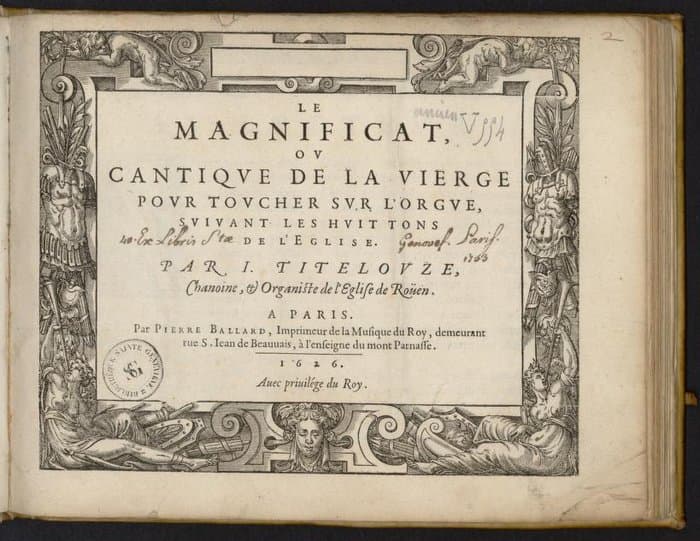
Le Magnificat, ou cantique de la Vierge pour toucher sur l’orgue, suivant les huit tons de l’Église
Paris, Pierre Ballard, 1626
Copy: Bibliothèque Sainte-Geneviève, via Internet Archive
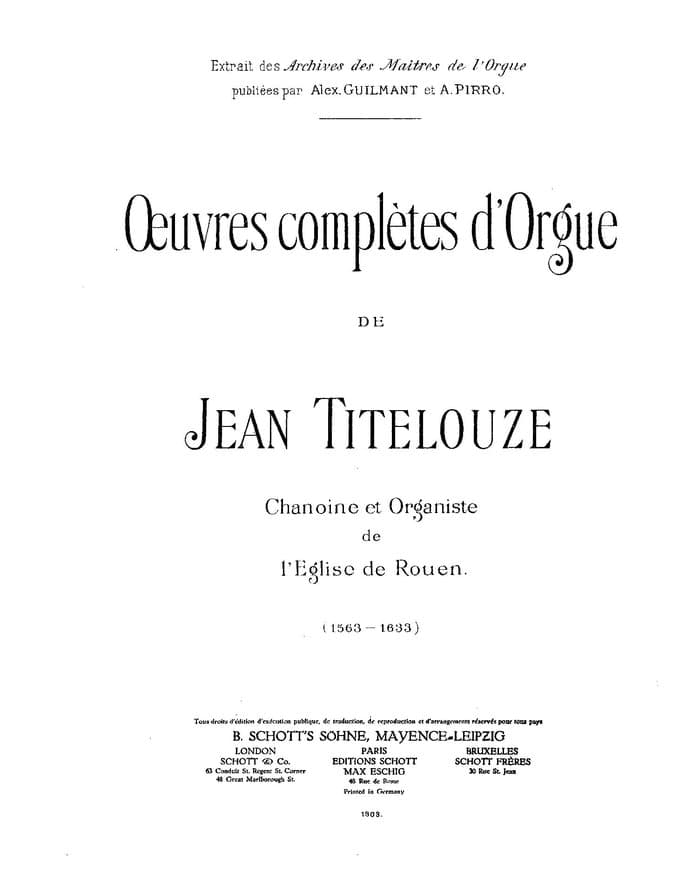
Archives des maîtres de l’orgue des XVIe, XVIIe et XVIIIe siècles (ed. Alexandre Guilmant and André Pirro), vol. 1: Œuvres complètes d’orgue de Jean Titelouze
Mainz, B. Schott’s Söhne, [1901-1914]
Copy: Ohio State University Libraries, via Internet Archive
At the head of the volume: biographical notice by André Pirro (1898), pp. VII–XV. Read the notice
Take part
This organ will be able to serve this music.