Baroque · French
Louis-Antoine Dornel
around 1680 to 1757
French Classical
Core repertoire
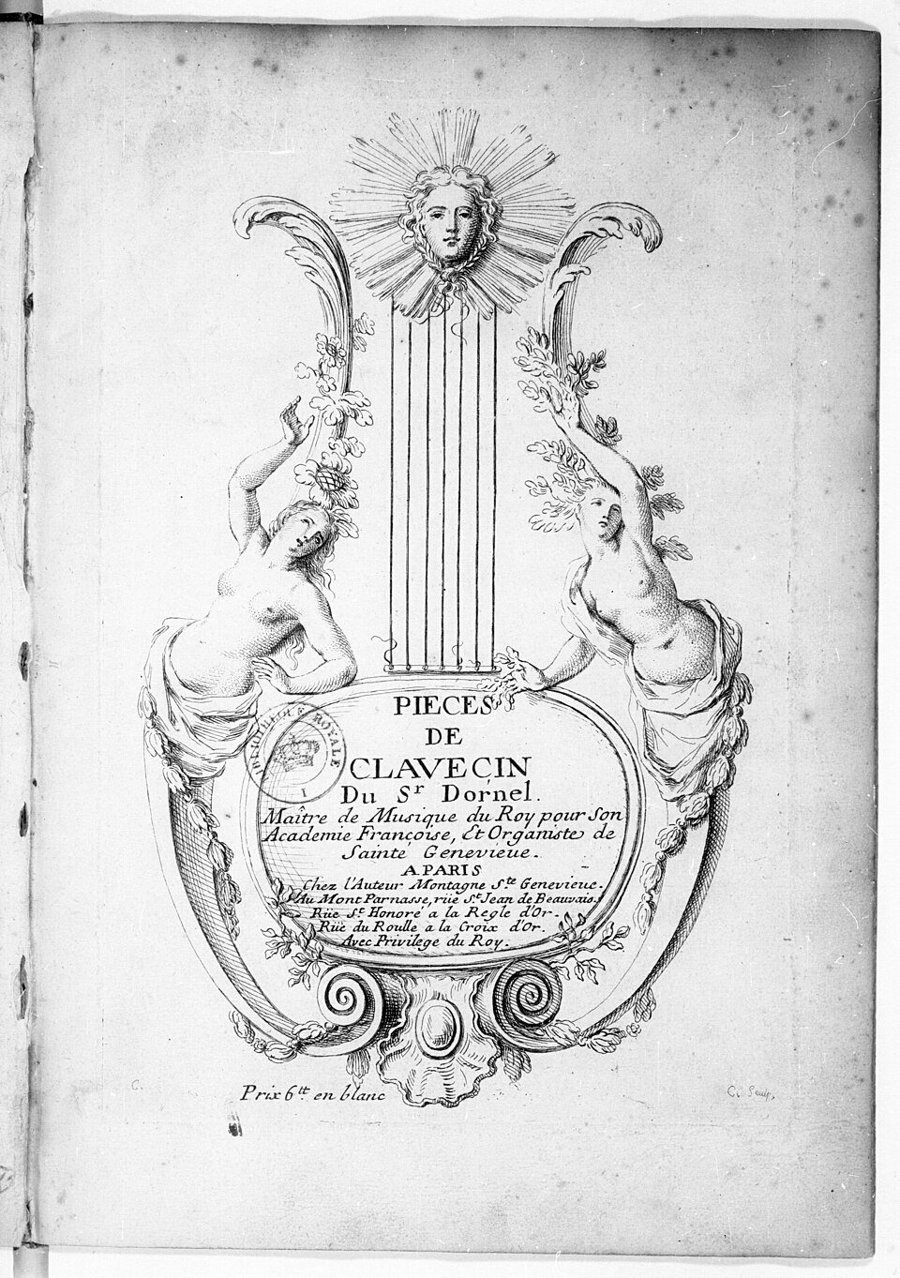
Image: BnF (Gallica btv1b9009730n), Wikimedia Commons, domaine public
Probably a pupil of Nicolas Lebègue, Louis-Antoine Dornel was appointed organist of Sainte-Marie-Madeleine-en-la-Cité in 1706, in place of Rameau, who had refused the terms of the post, and succeeded André Raison at the abbey of Sainte-Geneviève in 1719. Music master of the Académie française from 1725 to 1742, then organist of Saint-Germain-le-Vieil from 1748 to 1757, he left a manuscript book of organ pieces dated 1756.
The repertoire
Works in the project’s repertoire
1 work, available to listen to.
Core repertoire
This classification reflects the place of these repertoires within the artistic and educational orientations of the project. It does not constitute a technical indication regarding the design of the instrument.
Biography
Life and organ music
Louis-Antoine Dornel is said to have been born in Presles, near Beaumont-sur-Oise, on 30 March 1680, and to have died there on 22 July 1757; these dates, given by the encyclopaedia articles, remain disputed. An organist in Paris for half a century, at Sainte-Marie-Madeleine-en-la-Cité, at the abbey of Sainte-Geneviève and at Saint-Germain-le-Vieil, and music master of the Académie française from 1725 to 1742, he left sonatas, harpsichord pieces and a manuscript organ book dated 1756.
Key dates
- 30 March 1680
- Born in Presles (date disputed)
- 1 November 1706
- Organist of Sainte-Marie-Madeleine-en-la-Cité
- 1719
- Succeeds André Raison at the abbey of Sainte-Geneviève
- 1725
- Music master of the Académie française
- 1742
- Dismissed by the Académie, replaced by François Rebel
- 1748
- Organist of Saint-Germain-le-Vieil
- 1756
- Manuscript organ book, given to Father Mopinot
- 8 July 1757
- Resigns from Saint-Germain-le-Vieil
Obscure beginnings
Nothing is known of his training. He is generally said to have been a pupil of Nicolas Lebègue, organist of Saint-Merry and of the Chapelle royale. He also sought the advice of the organist Chauvet, to whom he dedicated his Sonates en trio in 1713, telling him that he owed him “all that the public may find best” in the work; the German Wikipedia article notes that an older and less reliable source makes Chauvet his teacher.
Even his dates are uncertain. The French, English and German articles give his birth in Presles on 30 March 1680 and his death there on 22 July 1757, but the French article admits further on that the exact date of his death is unknown. The Bibliothèque nationale de France writes “1680?-1757?” and records him as dying after 1756; Musicologie.org gives 1685–1765, and the English article reports that a handwritten inscription on the cover of his organ book gives 1691 and 1765.
Paris organ lofts
He first appears in 1706, at the competition for Sainte-Marie-Madeleine-en-la-Cité, which François d’Agincourt was leaving for Rouen Cathedral. The jury, made up of Nicolas Gigault, Jean-François Dandrieu and Claude Rachel de Montalan, judged Rameau the most skilful; but the rules forbade the successful candidate to play any other organ, and Rameau refused to give up those of the Jesuits in the rue Saint-Jacques and of the Mercedarian friars. “Sieur Dornel was received in his place”: he took possession of the organ on 1 November 1706. For a time he also played at Sainte-Geneviève-des-Ardents, which he left in 1714.
In 1716 he gave up the Madeleine for the abbey of Sainte-Geneviève, where he deputised for André Raison, who had held the organ for fifty years; the German article dates to 8 June 1716 the reversion of the post granted to him. He succeeded Raison on his death in 1719; Musicologie.org places the succession as early as 1716. The organ was in poor condition: in 1732 Dornel examined it with Nicolas Gilles Forqueray, organist of the Saints-Innocents, and in 1739 he was still addressing a petition in verse to the abbot on the instrument’s behalf. In 1732 too, he had motets of his own sung for the christening of new bells by a choir of more than eighty musicians, the Mercure de France reports. From 1731 to 1738, according to the German article, he was also organist of the Mathurins.
In 1748 he became organist of Saint-Germain-le-Vieil, on the Île de la Cité. His nephew and pupil Louis-Claude Gouffé deputised for him at Sainte-Geneviève as at Saint-Germain-le-Vieil, where Dornel resigned on 8 July 1757 “on account of his age and infirmities”. According to the German article, he had retired to Presles to live with his brother Jean, and on 29 June 1757 had given his nephew power of attorney to collect his annuities.
The Académie française and the Calotte
In 1725 he succeeded Jean-Baptiste Drouart du Bousset as music master of the Académie française. The post required him to have a motet of his own performed each year on the feast of St Louis, in the chapel of the Louvre; some were taken up at the Concert spirituel, such as the Domine Dominus noster in 1731. None survives. In 1742 the Académie dismissed him, judging his motets “very careless and almost always badly performed”, and replaced him with François Rebel. The French article suspects an intrigue; Pierre-Louis d’Aquin de Château-Lyon regretted that “a skilful man who all his life composed Latin music” had been so grieved.
The catalogue of the Concert spirituel collection describes him as a freemason, “a man of wit and very cheerful”. He also belonged to the Régiment de la Calotte, a burlesque fraternity founded at the beginning of the century; his Pièces de clavecin of 1731 end with a Concert calotin.
The organ book
Dornel published mainly chamber music, from 1709 onwards, and a treatise, Le Tour du clavier sur tous les tons (1745), devoted to keys then little used. The Mercure de France described his harpsichord and organ pieces as “highly esteemed and very easy to perform”.
His only organ book remained in manuscript. The autograph volume, of sixty-seven leaves, is kept at the Bibliothèque Sainte-Geneviève (Ms. 2365); some leaves have been torn out at the end. A note on the first leaf, apparently in the hand of Mercier de Saint-Léger, states that Dornel gave it in 1756 to Father Alexandre-Guillaume Mopinot, canon regular and librarian of Notre-Dame de Beaulieu, near Le Mans. Dated 1756, it brings together older pieces: the German article places some of them around 1705–1710, modelled on Guilain and Clérambault. It consists mostly of versets meant to alternate with the chant, notably sets of Magnificat versets; some pieces leave the church tones for more usual keys and betray Italian influence, such as a Dialogue de cromorne et cornet with dotted rhythms and unexpected chromaticism. Norbert Dufourcq published it in 1965 (1968 according to the German article). These pieces are in the site’s repertoire.
Sources
- Wikipedia (French), “Louis-Antoine Dornel”, consulted November 2026
- Wikipedia (English), “Louis-Antoine Dornel”, consulted November 2026
- Wikipedia (German), “Louis-Antoine Dornel”, consulted November 2026
- Bibliothèque nationale de France, authority record “Dornel, Louis Antoine (1680?-1757?)”
- Jean-Marc Warszawski, “Dornel Louis-Antoine, 1685-1765”, Musicologie.org
- Bibliothèque Sainte-Geneviève, MS 2365, “Pièces pour orgue d’Antoine Dornel”, Calames record
- Bibliothèque Sainte-Geneviève, MS 2365, digital facsimile (Internet Archive)
The sources
Digitised collections
Early editions and manuscripts containing works by this composer, digitised by libraries and available in full.
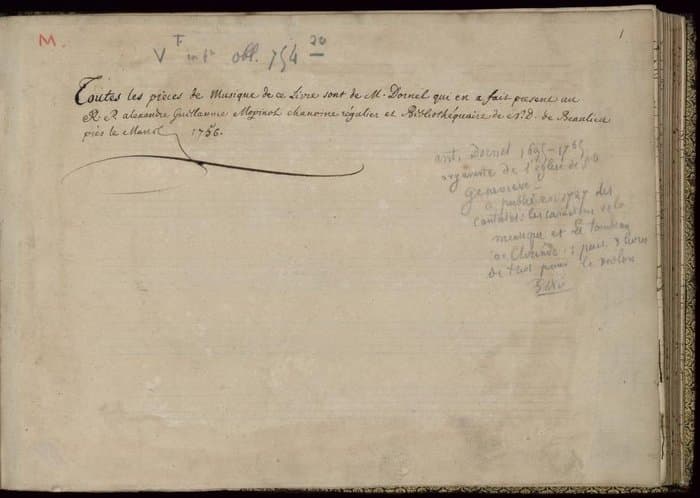
Pièces pour orgue d’Antoine Dornel
Manuscript, [before 1756]
Copy: Bibliothèque Sainte-Geneviève (Ms. 2365), via Internet Archive
Take part
This organ will be able to serve this music.