Baroque · French
Louis-Claude Daquin
1694 to 1772
French Baroque
Core repertoire
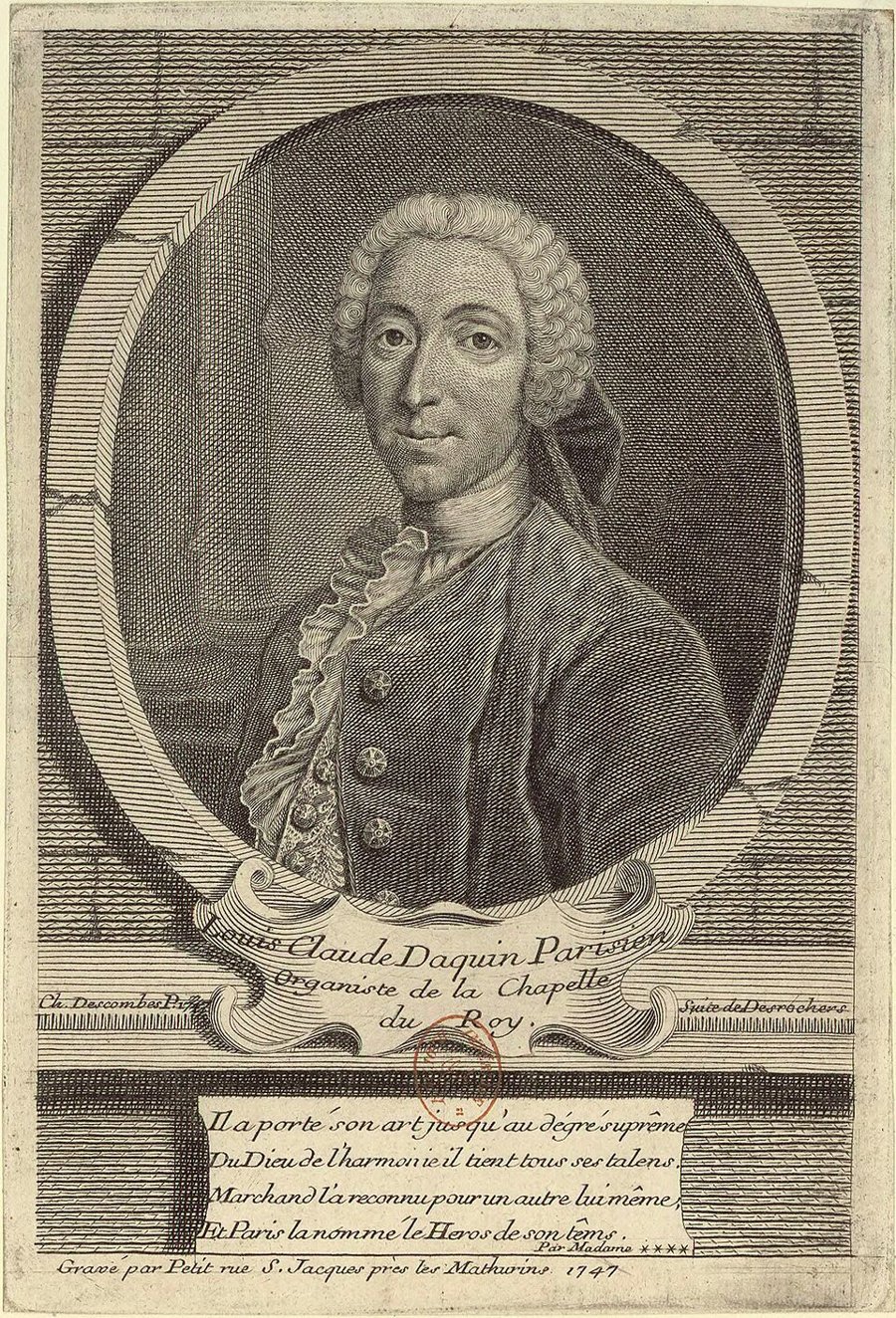
Image: Étienne-Jehandier Desrochers (BnF, Gallica btv1b10335274k), Wikimedia Commons, domaine public
A child prodigy presented to Louis XIV at the age of six and a pupil of Louis Marchand, Louis-Claude Daquin was organist of Saint-Paul (1727), the Cordeliers (1732), the Chapelle Royale (1739) and, from 1755, Notre-Dame de Paris. His "Nouveau livre de noëls" for organ and harpsichord (c. 1757) contains twelve varied noëls, among them the famous "Noël suisse." "Le Coucou," from his book of harpsichord pieces (1735), made his name with the wider public.
Wikipedia Scores on IMSLP Report an error
Organ loftsNotre-Dame Cathedral, Chapelle royale
The repertoire
Works in the project’s repertoire
5 works, all available to listen to.
Core repertoire
This classification reflects the place of these repertoires within the artistic and educational orientations of the project. It does not constitute a technical indication regarding the design of the instrument.
Biography
Life and organ music
Louis-Claude Daquin was born in Paris on 4 July 1694. A child prodigy who played before Louis XIV and a pupil of Louis Marchand, he held in turn the organs of Saint-Paul, the Cordeliers, the Chapelle Royale and, from 1755, Notre-Dame. A celebrated improviser, he left only one printed collection for the organ, the Nouveau livre de noëls of 1757; Le Coucou, which has kept his name alive, is a harpsichord piece.
Key dates
- 4 July 1694
- Born in Paris
- 1727
- Organist of Saint-Paul, preferred to Rameau
- 1732
- Organist of the Cordeliers, after Louis Marchand
- 1735
- Premier livre de pièces de clavecin, including Le Coucou
- 1739
- Organist of the Chapelle Royale, after Dandrieu
- 1755
- Titular organist of Notre-Dame de Paris, after Calvière
- 1757
- Nouveau livre de noëls pour l’orgue et le clavecin
- 15 June 1772
- Death in Paris
A child prodigy
According to the articles, the family descended from d’Aquinos who had come from Italy, of a Jewish line converted to Catholicism; the English article calls his father a painter, the French one a bourgeois of Paris. His godmother was the harpsichordist Élisabeth Jacquet de La Guerre, who, according to the German article, gave him his first lessons. He played before the court of Louis XIV at the age of six. He studied the organ with Louis Marchand and, according to the German article, composition with Nicolas Bernier; at eight he conducted his own Beatus vir.
The beginnings of his career are reported in two ways. According to the English article, at twelve he became organist of the Sainte-Chapelle, and the following year of the Petit-Saint-Antoine; according to the German article, at twelve he turned down the Sainte-Chapelle and accepted the Petit-Saint-Antoine. When he married Denise-Thérèse Quirot in 1722, the French article describes him as the king’s organist at the royal chapel of the Palais and a musician in ordinary to the Prince de Conti.
From Saint-Paul to Notre-Dame
In 1727 he was appointed organist of the church of Saint-Paul, where he was preferred to Jean-Philippe Rameau, also a candidate. In 1732 he succeeded his teacher Marchand at the Cordeliers, and in 1739 Jean-François Dandrieu as organist of the Chapelle Royale. Between 1749 and 1754 he appeared several times at the Concert Spirituel. Finally, in 1755, he became titular organist of Notre-Dame de Paris, succeeding Guillaume-Antoine Calvière.
His reputation rested first on his playing. The articles describe him as a virtuoso sought after by the aristocracy, whose organ playing drew crowds; the English article praises his precision and evenness at both harpsichord and organ, and the German one counts him among the foremost improvisers of his generation. Verses of the time, quoted by André Pirro, praise his duos: “When you make the figures of a duo shine, / You vary everything with such charm / That the divine Marchand, in his rich sallies, / Never gave us greater delight”.
The harpsichord book of 1735
The Premier livre de pièces de clavecin, published in 1735, contains twenty-eight pieces in four suites. Dances in the French tradition stand beside character pieces in the manner of Couperin and imitative or descriptive pieces, Les Vents en courroux, Les Plaisirs de la chasse, whose difficulty recalls Rameau rather. Les Trois Cadences contain a triple trill. Le Coucou, which opens the third suite, has become an encore for pianists such as Rachmaninoff and Cziffra: it is a harpsichord piece, not an organ piece.
The Nouveau livre de noëls
The Nouveau livre de noëls pour l’orgue et le clavecin, dont la plupart peuvent s’exécuter sur les violons, flûtes, hautbois, dedicated to the Comte d’Eu, appeared in 1757; the English article says “c. 1757”. The twelve noëls are variations on carol tunes, and their titles specify the registration: reeds without tremulant, cornet de récit and tierce du positif in dialogue, flute pedal, récit en taille, grand jeu. Noël X, “Grand jeu et duo”, and Noël XII, known as the Noël suisse, have remained the most often played. The French article regards the collection as the most accomplished of this typically French genre.
The lost works and the end
The rest of his output is largely lost. Apart from these two books, there survive only a cantata, an air à boire and, in manuscript, two masses, a Te Deum, a Miserere and Leçons de ténèbres. His son, Pierre-Louis d’Aquin de Château-Lyon, a man of letters, recounted his father’s career as early as 1752 in his Lettres sur les hommes célèbres du règne de Louis XV; it is he, too, who in that book praises Clérambault as an “organist, and an esteemed organist”. Louis-Claude Daquin died in Paris on 15 June 1772.
Sources
- Wikipedia (French), “Louis-Claude Daquin”, consulted November 2026
- Wikipedia (English), “Louis-Claude Daquin”, consulted November 2026
- Wikipedia (German), “Louis-Claude Daquin”, consulted November 2026
- IMSLP, “Livre de Noëls, Op.2 (Daquin, Louis-Claude)”, title, dedication and date of publication
- André Pirro, notice “Louis-Nicolas Clérambault”, Archives des maîtres de l’orgue, vol. 3, 1901, p. 89 (verses on Daquin; Internet Archive)
- Bibliothèque nationale de France, authority record “Daquin, Louis-Claude (1694-1772)”
Take part
This organ will be able to serve this music.