Baroque · French
Louis Marchand
1669 to 1732
French Classical
Core repertoire
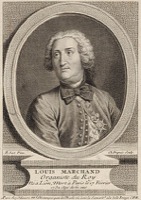
Legendary keyboard virtuoso, Louis Marchand was organist at several Parisian churches and the Royal Chapel. Tradition holds that he evaded a musical duel with Bach in Dresden in 1717.
Wikipedia Scores on IMSLP Report an error
Organ loftsChapelle royale
The repertoire
Works in the project’s repertoire
9 works, all available to listen to.
Core repertoire
This classification reflects the place of these repertoires within the artistic and educational orientations of the project. It does not constitute a technical indication regarding the design of the instrument.
Biography
Life and organ music
Louis Marchand was born in Lyon on 2 February 1669 and died in Paris on 17 February 1732. Organist of several Parisian churches, then one of the four organists to the King from 1708 to 1713, he was regarded in his lifetime as one of the greatest keyboard virtuosos. His life, full of lawsuits and scandals, gave rise to many anecdotes, not all of them reliable; his surviving work is small and dates mostly from his youth.
Key dates
- 2 February 1669
- Born in Lyon (1671 according to his engraved portrait)
- c. 1689
- Settles in Paris; marriage to Marie-Angélique Denis
- 1699
- First book of harpsichord pieces
- June 1708
- Organist to the King, July quarter, succeeding Nivers
- 1713
- Gives up his posts and leaves for Germany
- September 1717
- Stay in Dresden; contest with Bach according to later German sources
- 17 February 1732
- Death in Paris
From Lyon to Paris
He came from a family of organists. His portrait, engraved after his death, gives his age as sixty-one, which would place his birth in 1671. According to the English Wikipedia article, his father Jean was organist of Clermont-Ferrand Cathedral before settling in Nevers in 1684, at the church of Saint-Martin. Titon du Tillet wrote in 1732 that this father, “a mediocre organist”, taught him the rudiments of his art, and that the son was organist of Nevers Cathedral at fourteen, then for four or five years of Auxerre Cathedral. The French article repeats both posts; the English article points out that no document confirms his time at Nevers Cathedral, apart from a contract signed with his father for the enlargement of the Saint-Martin organ.
Around 1689 he was in Paris, where he married Marie-Angélique Denis, daughter of the harpsichord maker Jean Denis. His marriage contract describes him as organist of a church of Saint-Jacques on the Left Bank; Musicologie.org places him in 1691 at the Jesuit church in the rue Saint-Jacques, and Titon du Tillet names the Jesuit college and professed house. Then came Saint-Benoît, the great convent of the Cordeliers and Saint-Honoré, where Musicologie.org places him from 1703 to 1707. Titon du Tillet maintains that almost every vacant organ in Paris was offered to him.
Organist to the King
In June 1708 he succeeded Guillaume-Gabriel Nivers as one of the four organists to the King, serving the July to September quarter, for a stipend of six hundred livres. Virtually all contemporary accounts praise his playing, but several affairs are well documented: soon after arriving in Paris he joined the organ builder Henry Lesclop in a plot against Pierre Dandrieu, organist of Saint-Barthélemy, whose post he coveted; his wife, whom he beat, obtained a separation in 1701 and the return of part of her dowry.
In 1713 he gave up his organs, “even that of the King’s Chapel”, as Titon du Tillet writes (Musicologie.org excepts the Cordeliers, where he lodged), and left for Germany. The reason is not known. Edward Higginbottom saw it as an escape from his former wife’s demands; Marpurg, in 1754–1755, spoke of exile after an insolent retort to the King. Another story, which belongs to legend, has it that when the King had half his salary paid to his wife, he broke off in the middle of mass, declaring that she might as well play half the service.
Dresden, 1717
According to Titon du Tillet, he played before the Emperor and several Electors, who would have liked to keep him. Dresden, in September 1717, is the setting for the best-known episode of his life: a keyboard contest with Johann Sebastian Bach, which Marchand is said to have avoided by leaving the city early in the morning. The story is told only by later German sources, Marpurg, Jakob Adlung, then Bach’s biographers such as Forkel; Marpurg was not born in 1717, and no French document mentions it. Titon du Tillet does not know of it and says only that Marchand missed Paris. The English article recalls the rumour that he was about to be offered a post in the court chapel, to the annoyance of the musicians there, and that the Konzertmeister Volumier probably brought Bach in against him; the same Adlung reports that Bach played Marchand’s harpsichord suites from memory.
The Cordeliers
Back in Paris, Marchand took up the organ of the Cordeliers again, which brought him nothing, according to Titon du Tillet, but lodging in the convent; the church filled whenever he was due to play. The same author tells how, his left arm injured six or seven years before his death, he played for three or four months with one hand and the pedals. He taught: Pierre Du Mage, who praised him in the preface to his Premier livre d’orgue of 1708, and Louis-Claude Daquin were his pupils; the French article adds Jean-Adam Guilain among his known or supposed pupils. He died in Paris on 17 February 1732; Titon du Tillet’s text as reproduced by Musicologie.org gives February 1731, and has him buried in the cemetery of the Saints-Innocents.
The organ works
Twelve pieces were published under the title Livre premier: by his daughter, through the widow Boyvin, in the year of his death, according to the French article; in 1740 by the Boivin firm, according to the English article, which takes it to reproduce a book published in January 1700 of which no copy is known. Some forty other pieces, among them a Te Deum, remained in manuscript at Versailles. They include the Grand Dialogue in C, dated 1696, a harmonically dissonant Fond d’orgue, a fugal Quatuor and a Plein jeu with two independent parts in the pedals. These pieces almost never draw on plainchant. Alexandre Guilmant published them in 1901 in the Archives des maîtres de l’orgue. For the harpsichord there remain two books of pieces, the first issued in 1699 and reissued by Ballard in 1702 together with a second. Titon du Tillet mentions an opera, Pyrame et Thisbé, never staged, and a chest of music found by his daughter; Sébastien de Brossard thought well of his Règles de la composition.
Take part
This organ will be able to serve this music.