Baroque · French
Louis-Nicolas Clérambault
1676 to 1749
French Classical
Core repertoire
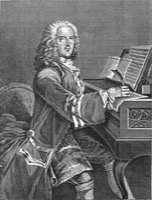
Organist at the Maison royale de Saint-Cyr, where he succeeded Nivers in 1714, and from 1715 at Saint-Sulpice, where he succeeded Totin, Clérambault is chiefly renowned for his French cantatas. His "Suite du deuxième ton" for organ is a model of elegance and clarity in the French classical style.
« Venant après des compositions d’un genre plus libre, les pièces d’orgue en gardent la grâce et la variété. »
English translation: “Coming after compositions in a freer genre, the organ pieces keep their grace and variety.”
Wikipedia Scores on IMSLP Report an error
Organ loftsSaint-Sulpice
The repertoire
Works in the project’s repertoire
8 works, all available to listen to.
Core repertoire
This classification reflects the place of these repertoires within the artistic and educational orientations of the project. It does not constitute a technical indication regarding the design of the instrument.
Biography
Life and organ music
Louis-Nicolas Clérambault was born in Paris on 19 December 1676 into a family of the king’s violinists. A pupil of André Raison and organist of Saint-Cyr, Saint-Sulpice and the Jacobins of the rue Saint-Jacques, he owed his fame to his French cantatas, which Louis XIV heard with pleasure. For the organ he published only one book of two suites, which appeared in 1710 and was dedicated to his teacher.
Key dates
- 19 December 1676
- Born in Paris
- c. 1696
- Organist of Saint-Louis, Saint-Cyr, according to Pirro (1714 according to present-day articles)
- 1704
- Pièces de clavecin; organist of the Grands-Augustins
- 1710
- Premier livre d’orgue, dedicated to André Raison
- 1714
- Succeeds Nivers at Saint-Cyr; Saint-Sulpice in 1714 or 1715
- 1719
- Organist of the Jacobins, rue Saint-Jacques, after Raison
- 26 October 1749
- Death in Paris; buried at Saint-Sulpice
A family of royal musicians
His father, Dominique Clérambault, was one of the Vingt-quatre Violons du Roi; the family, as André Pirro recalls in the notice he wrote in 1901 for the Archives des maîtres de l’orgue, had served the kings of France since Louis XI. The boy learnt the violin and harpsichord very early from his father, the organ from André Raison, organist of the abbey of Sainte-Geneviève, and composition and singing from Jean-Baptiste Moreau. According to Pirro, he had written a motet for full choir by the age of thirteen.
Saint-Cyr and the cantatas
The sources do not agree on when he entered the Maison royale de Saint-Louis at Saint-Cyr, the school for girls of the impoverished nobility. Pirro writes that at twenty, that is around 1696, he was organist of the church of Saint-Louis at Saint-Cyr and directed Madame de Maintenon’s music. Present-day articles have him succeed Guillaume-Gabriel Nivers on the latter’s death in 1714, despite the reversion Nivers had obtained for his nephew Jean-Baptiste Totin; they place in 1710 his appointment as superintendent of Madame de Maintenon’s private music, after one of his cantatas had pleased Louis XIV. At Saint-Cyr he played the organ and rehearsed the chants and choruses, and he kept the post after the death of Madame de Maintenon.
These were the years of the cantatas, a genre of which he is considered the master. Five books appeared between 1710 and 1726; Pirro dated the first to 1700. They include Orphée, the most famous, Médée, and Léandre et Héro. In the foreword to the third book (1716) he recalls the success of these works “when they were performed before the King”. In 1704 he had published a book of harpsichord pieces, in which he adopts the unmeasured prelude.
The organ book of 1710
The Premier livre d’orgue brings together two suites, on the first and second tones: grand plein jeu, fugue, duo, trio, basse et dessus de trompette, récits on the flutes or the nazard, dialogue and caprice. Clérambault dedicated it to Raison, “to make known to the public that if these pieces have any success, it is the fruit of the learned lessons I received from so excellent a master as you”. These two suites seem intended to open a cycle in all the tones, which was never continued.
Pirro judged that, “coming after compositions in a freer genre, the organ pieces keep their grace and variety”; present-day articles likewise say that melodic charm prevails in them over religious spirit. Pirro notes that Clérambault could not claim, as Du Mage did, to belong to Louis Marchand’s school, and that he was not reputed a great harpsichordist; yet in 1752 the son of Louis-Claude Daquin, in his Lettres sur les hommes célèbres, names him an “organist, and an esteemed organist”.
The Paris organ lofts
According to the French article, he had been organist of the Grands-Augustins since 1704. At Saint-Sulpice he succeeded Nivers in 1714 according to the same article; the list of the organ’s titulars, however, places Totin between 1702 and about 1714 and has Clérambault begin only in 1715. In 1719 he succeeded Raison at the Jacobins of the rue Saint-Jacques; Pirro, who had found his name in the convent’s registers only from 1728, observed that he already bears this title in his fourth book of cantatas in 1720, and that he was paid sixty livres a year there.
After the last book of cantatas, Pirro finds little more than a few motets until the Idylle de Saint-Cyr, given in 1745 before the Dauphin. Pirro saw in this the weight of his three posts, that of a growing family, and a change in taste; in 1735 the Jacobins had to advance him half a year’s salary. He died in Paris on 26 October 1749 and was buried at Saint-Sulpice. His son César-François-Nicolas succeeded him at Saint-Sulpice, Saint-Cyr and the Jacobins; another son, Évrard-Dominique, later followed his brother.
Sources
- André Pirro, notice “Louis-Nicolas Clérambault”, Archives des maîtres de l’orgue, vol. 3, 1901, pp. 89–91 (Internet Archive)
- André Pirro, notice “André Raison”, Archives des maîtres de l’orgue, vol. 2, 1899 (dedication of the 1710 organ book; Internet Archive)
- Wikipedia (French), “Louis-Nicolas Clérambault”, consulted November 2026
- Wikipedia (English), “Louis-Nicolas Clérambault”, consulted November 2026
- Wikipedia (French), “Grand orgue de l’église Saint-Sulpice”, list of organists, consulted November 2026
- Bibliothèque nationale de France, authority record “Clérambault, Nicolas (1676-1749)”
The sources
Digitised collections
Early editions and manuscripts containing works by this composer, digitised by libraries and available in full.
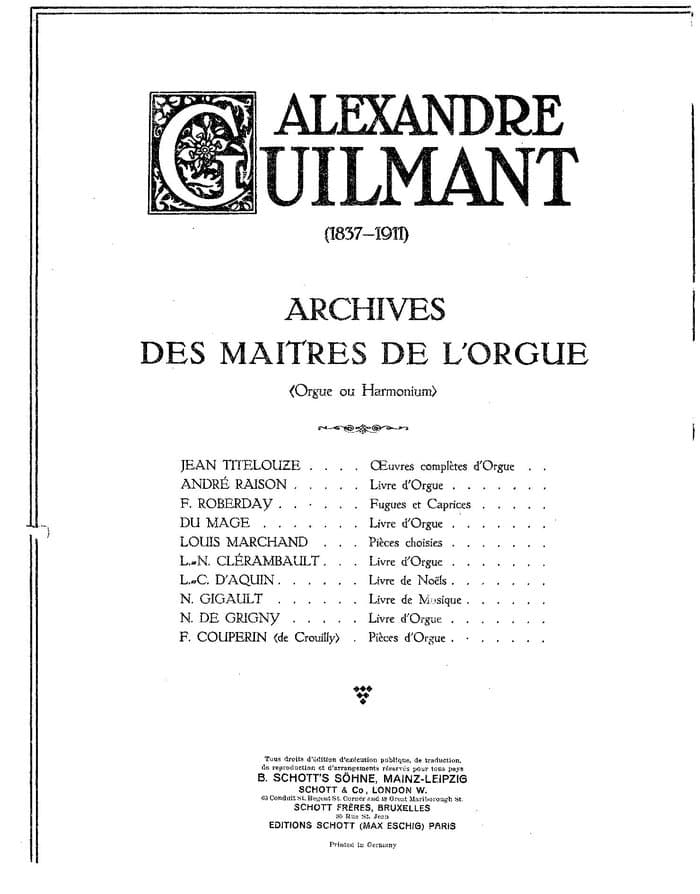
Archives des maîtres de l’orgue des XVIe, XVIIe et XVIIIe siècles (ed. Alexandre Guilmant and André Pirro), vol. 3: Clérambault, Premier livre d’orgue; Roberday, Fugues et caprices
Mainz, B. Schott’s Söhne, [1901-1914]
Copy: Ohio State University Libraries, via Internet Archive
At the head of the volume: biographical notice by André Pirro (1901), pp. 89–91. Read the notice
Take part
This organ will be able to serve this music.