Baroque · French
Michel Corrette
1707 to 1795
French Baroque
Core repertoire
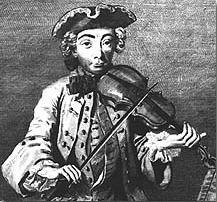
Son of the organist Gaspard Corrette, Michel Corrette was organist of Sainte-Marie du Temple in Paris from 1737 to 1791 and, for a time, of the Jesuit church. He published three books of organ music (1737, 1750, 1756) and a "Nouveau livre de noëls" (1741), as well as numerous instrumental and accompaniment methods that shed light on the musical practice of his time. His idiom, which remained faithful to the Baroque style into the 1770s, touches on galant turns of phrase.
The repertoire
Works in the project’s repertoire
1 work, available to listen to.
Core repertoire
Premier livre d’orgue, op. 16
Prelude and Fugue
Core project repertoire
This classification reflects the place of these repertoires within the artistic and educational orientations of the project. It does not constitute a technical indication regarding the design of the instrument.
Biography
Life and organ music
Michel Corrette was born in Rouen on 10 April 1707 and died in Paris in January 1795. The son of the organist Gaspard Corrette, he played the organ of Sainte-Marie du Temple in Paris for fifty-four years and, for a time, that of the Jesuits. A prolific author of concertos comiques and of methods for almost every instrument, he remained faithful to the organ all his life: three organ books, noëls, keyboard concertos and, in 1787, Pièces pour l’orgue dans un genre nouveau.
Key dates
- 10 April 1707
- Born in Rouen (1709 according to the Dictionnaire de biographie française)
- 1720
- Arrives in Paris
- 1726
- Competition at Sainte-Marie-Madeleine-en-la-Cité
- 1737
- Organist of Sainte-Marie du Temple; Premier livre d’orgue
- 1750
- Second organ book
- 1756
- Third organ book; concertos op. 26
- 1787
- Pièces pour l’orgue dans un genre nouveau
- 21 January 1795
- Death in Paris
From Rouen to Paris
He was the son of Gaspard Corrette, organist of Saint-Herbland in Rouen, and Marguerite Thérèse Vérard. His training, probably begun with his father, a friend of Jacques Boyvin, organist of the cathedral, continued in Paris, where he arrived in 1720. The Bibliothèque nationale de France notes that the Dictionnaire de biographie française gives 1709 as his year of birth.
In 1726 he entered the competition for the organ of Sainte-Marie-Madeleine-en-la-Cité; according to the French and English Wikipedia articles, the three candidates played equally well, but the post went to Thoutain. Musicologie.org, on the contrary, has him organist of that church from 1726 to 1790. He then earned his living by teaching, and from 1727 published his first collections of sonatas. On 8 January 1733 (8 July according to Musicologie.org) he married Marie-Catherine Morize; their son Pierre-Michel, born in 1744, also became an organist.
The Temple and the Jesuits
In 1737 he became organist of Sainte-Marie du Temple, in the service of the grand priors of France, members of the royal family: according to the French article, the chevalier d’Orléans, then the prince de Conti, prior from 1749 to 1776, then the duc d’Angoulême, who appointed him his organist in 1780; Musicologie.org names the duc de Condé for 1757. He kept this post until the Revolution closed the church in 1791.
He also played the organ for the Jesuits, but the sources differ on the church and the dates. According to the French article, the title page of his book of noëls of 1741 already describes him as organist of the Maison professe, the church of Saint-Louis in the rue Saint-Antoine; Musicologie.org quotes the title of his second organ book, in 1750, which calls him “organist of the church of the Jesuit Fathers of the Maison professe in the rue S. Antoine”. The English and German articles place him instead at the Jesuit College, from 1758 to 1762. All agree on the end: he lost the post in 1762, when the Society was expelled.
Fairs and methods
In the 1730s he directed the music at the Saint-Laurent and Saint-Germain fairs, where the opéra-comique theatres performed his concertos comiques, danced entertainments on popular tunes; there were twenty-five of them, up to 1773. From 1748 he held weekly concerts at home with his pupils and amateurs, at which he performed his concertos for organ or harpsichord, among the first keyboard concertos written in France, and spread Italian music.
Above all he published nearly twenty methods, for the violin, cello, double bass, flute, hurdy-gurdy, guitar, mandolin, harp or voice; his treatises on accompaniment, Le Maître de clavecin (1753) and the Prototypes (1754), were very successful. These works shed light on the musical practice of his time. According to the English article, his idiom remained Baroque at least until the 1770s.
The organ music
The Premier livre d’orgue (1737) and the second (1750) bring together suites of Magnificat versets, on the first four tones and then on the last four. The Nouveau livre de noëls, with a carillon for harpsichord or organ, appeared in 1741 and again in 1753. The Troisième livre d’orgue (1756) contains “the masses and hymns of the Church”: plainchants to be played in trio on the trumpet of the great organ, with the fleurti on the plein jeu of the positif, others in four parts on the grand plein jeu with pedals, and easy fugues. The six concertos op. 26 (1756), for obbligato harpsichord or organ, can be played on the organ without orchestra, except the third; the composer advises playing the allegros on the grand jeu, the adagios on the flutes and the solos on the cornet de récit.
Then came twelve offertories (1766, or 1764 according to Musicologie.org), long thought lost, since rediscovered and acquired by the Bibliothèque nationale de France, and in 1787 the Pièces pour l’orgue dans un genre nouveau, à l’usage des Dames religieuses, “with the mixture of stops and the manner of imitating thunder”: according to the French article, the last organ book of the Ancien Régime. Michel Rusquet considers the first two books minor, but engaging for their melodic invention and their search for colour, and finds the composer more at ease in the noëls. The Premier livre d’orgue is in the site’s repertoire.
The Revolution
The Revolution deprived him of the Temple in 1791; the church was sold and demolished a few years later. He took an interest in events and wrote occasional pieces, now lost: in 1790 an advertisement announced a patriotic ariette on the refrain “Ah! ça ira”, “by M. Corrette, organist of the Temple”. He died in Paris on 21 January 1795, aged eighty-seven, according to the encyclopaedia articles; Musicologie.org gives “2 January 1795 (3 Pluviôse, year III)”. A street in Rouen bears his name.
Sources
- Wikipedia (French), “Michel Corrette”, consulted November 2026
- Wikipedia (English), “Michel Corrette”, consulted November 2026
- Wikipedia (German), “Michel Corrette”, consulted November 2026
- Bibliothèque nationale de France, authority record “Corrette, Michel (1707-1795)”
- Jean-Marc Warszawski, “Corrette Michel, 1707-1795”, Musicologie.org
- Michel Rusquet, “L’œuvre instrumentale de Michel Corrette”, Musicologie.org
Take part
This organ will be able to serve this music.