Baroque · French
Nicolas Lebègue
around 1631 to 1702
French Classical
Core repertoire
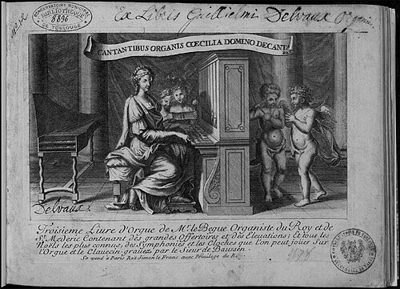
Image: Wikimedia Commons (source d’origine non précisée dans la notice), domaine public
Organist at Saint-Merri in Paris and one of the founders of the French classical organ school, Nicolas Lebègue published three books of organ music that became authoritative. He contributed to codifying the forms and registrations of the genre.
Wikipedia Scores on IMSLP Report an error
Organ loftsChapelle royale, Saint-Merry
The repertoire
Works in the project’s repertoire
8 works, 6 of them available to listen to.
Core repertoire
This classification reflects the place of these repertoires within the artistic and educational orientations of the project. It does not constitute a technical indication regarding the design of the instrument.
Biography
Life and organ music
Nicolas-Antoine Lebègue was born in Laon around 1631 and died in Paris on 6 July 1702. Organist of Saint-Merry for nearly forty years, one of the four organists to the King appointed in 1678, and a much sought-after expert in organ building, he published three organ books in 1676, 1678 and 1685. Several of the forms that define the French classical organ are owed to him, among them the récit de tierce en taille, and Nicolas de Grigny was among his pupils.
Key dates
- c. 1631
- Born in Laon
- 1661
- Called to Troyes as the “famous organist of Paris”
- 18 December 1664
- Organist of Saint-Merry
- 1676
- First organ book
- 1678
- Organist to the King, October quarter; second organ book
- 1685
- Third organ book
- 1687
- Second book of harpsichord pieces and motets
- 6 July 1702
- Death in Paris
From Laon to Saint-Merry
He was the son and grandson of millers. His father, Antoine Lebègue, married on 17 November 1630 Marie Le Nain, a first cousin of the three painter brothers, who also came from Laon. Of his youth and training almost nothing is known. An uncle, Nicolas Lebègue, a “maître joueur d’instruments”, may have played a part; the German Wikipedia article mentions a singing school in Laon, and the French article considers it possible that he studied with Chambonnières, several of whose pupils he certainly knew.
He settled in Paris in the mid-1650s, around 1656 according to the French article. The first known document concerning him dates from 1661: the registers of Troyes Cathedral, where he had come to examine the organ and give a concert, call him the “famous organist of Paris”. He must therefore have held a Parisian post by then, though which is unknown. The only post on record is that of Saint-Merry, from 18 December 1664 until his death. According to Musicologie.org, he owed it four hundred services a year, not necessarily in person, and paid the organ blowers himself.
Organist to the King
In 1678 he was appointed one of the four organists of the Chapel Royal, with Guillaume-Gabriel Nivers, Jacques Thomelin and Jean-Baptiste Buterne, after the death of Chabanceau de La Barre, until then the sole holder; the French article on Lebègue gives his first name as Joseph, the one on Nivers as Jacques. Musicologie.org gives him the October quarter. The article on the Chapelle royale assigns the same allocation of quarters to 1693, after the arrival of François Couperin; the articles on Lebègue and Nivers place it in 1678.
His knowledge of organ building took him beyond Paris: Chartres in 1671, Soissons in 1680, Laon in 1697, Blois in 1699, Bourges; in Paris, the Invalides in 1679. He never married. The German article reports that a swindler cost him a large part of his fortune in the 1690s, and that his health declined; the inventory drawn up after his death lists a harpsichord by Denis, a theorbo, two viols and a violin. He died on 6 July 1702, in the rue Simon-le-Franc.
The three organ books
The first book, in 1676, gathers eight suites in the eight church tones. Its title announces “the manner of playing the organ at present on all the stops, and particularly those little used in the provinces, such as the tierce and cromorne en taille”. Lebègue was probably the first in France to give the pedal an independent part, in trios on three manuals and in the récit en taille, where the left hand plays an ornamented melody on the tierce or cromorne, the right hand accompanies on another manual and the pedal holds the bass. He also developed the trio à deux dessus. The book was reissued by Lesclop in 1682.
The Second livre d’orgue of 1678, made up of “short and easy pieces on the eight church tones and the Mass for solemn feasts”, was aimed at amateurs: according to the publisher, the composer forced himself to restrain the fire of his playing, and the pedal is no longer obligatory. The Troisième livre, in 1685, brings together ten offertories, eight elevations, four symphonies in the manner of Lully’s overtures, nine noëls with variations, among the earliest of the genre, and Les Cloches. Some twenty other pieces remain in manuscript, and sixteen have been identified among the anonymous pieces of the Livre d’orgue de Montréal.
Harpsichordist and teacher
His two books for harpsichord, of 1677 (1676 according to the English article) and 1687, contain the first printed unmeasured preludes, written in a simplified notation to make them readable by all; two of his suites were wrongly attributed to Buxtehude. In 1687 he also published motets, written for the Benedictine nuns of the Val-de-Grâce, in which the organ at times takes a concertante part.
His best-known pupils were François d’Agincourt and Nicolas de Grigny; Jean-Nicolas Geoffroy and Gilles Jullien probably studied with him too; the French and German articles add Pierre Dandrieu. It was through him that Pierre Du Mage obtained his first important post, at the collegiate church of Saint-Quentin. The very many copies of his music bear witness to how widely it circulated.
Sources
- Wikipedia (French), “Nicolas Lebègue”, consulted November 2026
- Wikipedia (English), “Nicolas Lebègue”, consulted November 2026
- Wikipedia (German), “Nicolas Lebègue”, consulted November 2026
- Wikipedia (French), “Chapelle royale (Ancien Régime)”, consulted November 2026
- Jean-Marc Warszawski, “Lebègue [Le Bègue] Nicolas, 1631-1702”, Musicologie.org, 2012
Take part
This organ will be able to serve this music.