Baroque · French
Pierre Dandrieu
1664 to 1733
French Classical
Core repertoire
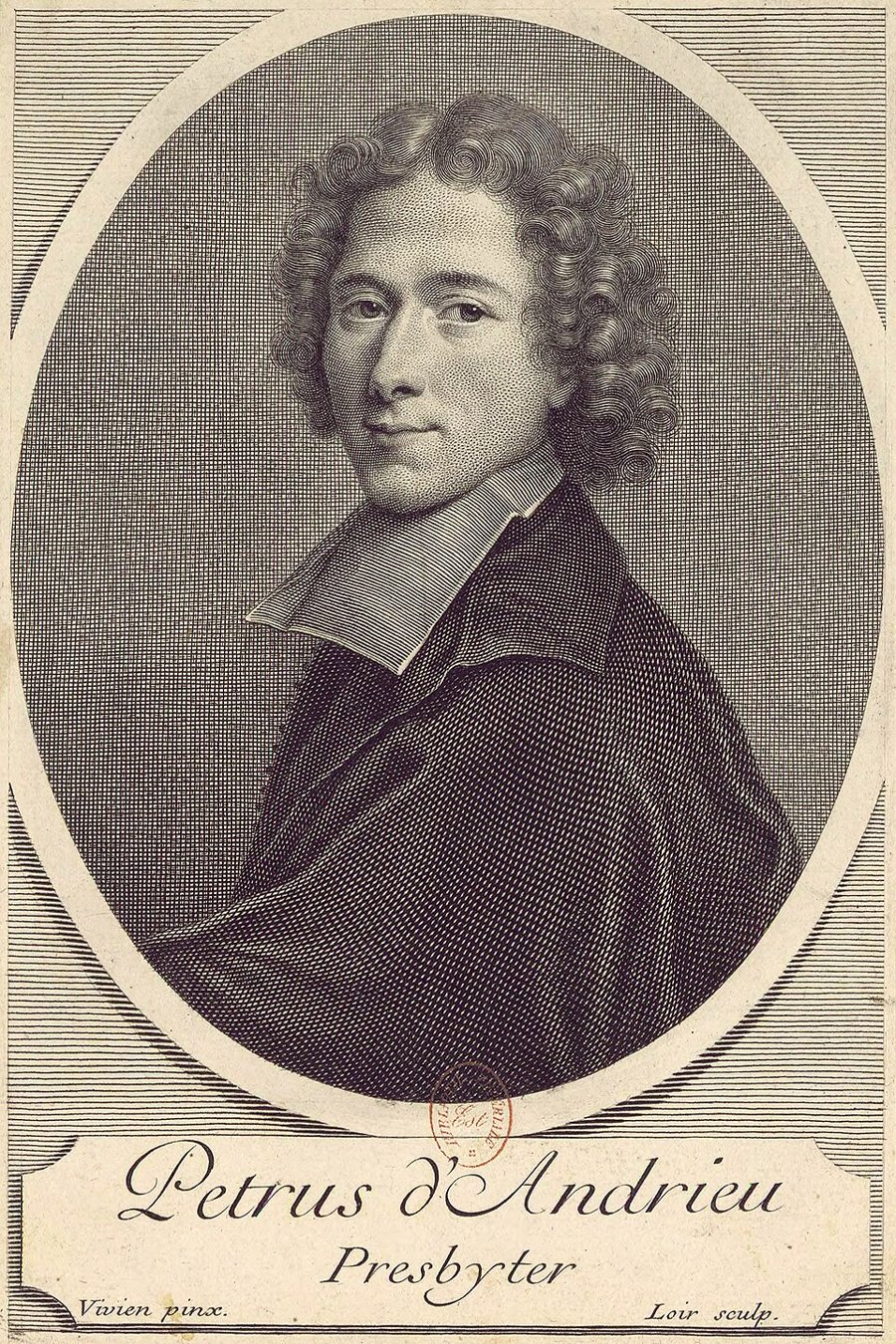
Image: BnF (Gallica btv1b85307528), Wikimedia Commons, domaine public
A pupil of Lebègue, Pierre Dandrieu was organist of Saint-Barthélemy on the Île de la Cité for more than forty years; his nephew Jean-François Dandrieu succeeded him in 1733. Around 1714 he published a collection of noëls, O filii, Saint-Jacques songs and carillons for organ or harpsichord.
The repertoire
Works in the project’s repertoire
5 works, all available to listen to.
Core repertoire
This classification reflects the place of these repertoires within the artistic and educational orientations of the project. It does not constitute a technical indication regarding the design of the instrument.
Biography
Life and organ music
Pierre Dandrieu, or d’Andrieu, was baptised in Angers on 21 March 1664 and died in Paris on 20 October 1733. A priest and a pupil of Nicolas Lebègue, he played the organ of the church of Saint-Barthélemy, on the Île de la Cité, for more than forty years, and was succeeded there by his nephew Jean-François. Around 1714 he published a book of noëls with variations for organ or harpsichord, which this nephew later reworked and which appeared in its new form only in 1759.
Key dates
- 21 March 1664
- Baptised in Angers
- August 1697
- First air published by Ballard
- c. 1714
- Book of noëls for organ and harpsichord
- 1721–1733
- Revised and enlarged edition of the collection
- 20 October 1733
- Death in Paris; his nephew succeeds him at Saint-Barthélemy
- 1759
- The collection reappears, reworked, under the name of Dandrieu
From Angers to Saint-Barthélemy
The Dandrieu family came from Angers, where Pierre was baptised. He studied in Paris with Nicolas Lebègue, organist of Saint-Merry and of the Chapelle royale, whose influence the German Wikipedia article detects in his style. A priest, he became organist of Saint-Barthélemy, a parish on the Île de la Cité since destroyed, and kept that post for more than forty years. He also published three airs in Ballard’s Recueils d’airs sérieux et à boire: “Mes yeux par leur langueur extrême” in August 1697, then, in April 1699, “L’amour s’est fait pour la jeunesse” and “Petits oyseaux sous ces feuillages”.
His appointment aroused envy. According to the English Wikipedia article on Louis Marchand, Marchand, recently arrived in Paris, coveted the organ of Saint-Barthélemy; together with the organ builder Henry Lesclop, he tried to defame the new organist by having him accused of fathering a young girl’s child. Dandrieu lodged a complaint against Lesclop and, during the inquiry, the girl withdrew her accusation. The notice on Marchand at Musicologie.org connects this episode with the year 1691.
The uncle lived with the family of Jean d’Andrieu, Jean-François’s father, in a large house in the rue Sainte-Anne, “near the Palais”. The nephew, born around 1682, and the niece Jeanne-Françoise both became organists and harpsichordists; the German article finds it natural to suppose that the uncle gave the nephew his first lessons.
The book of noëls
Around 1714 Pierre Dandrieu published a book of forty-two noëls and other pieces, mainly for organ, or for harpsichord. The collection reappeared in a revised edition between 1721 and 1733; the encyclopaedia articles report that the BnF dates it to about 1725, while its authority record cites an edition of about 1729. The title sums up its contents: Noëls, O filii, chansons de Saint-Jacques, Stabat Mater et carillons, “all revised, enlarged and extremely varied, and set for the organ and for the harpsichord, by Mr Dandrieu, priest and organist of St Barthelemy in Paris”.
It contains thirty-seven noëls, among them “Une jeune pucelle”, “Joseph est bien marié”, “Où s’en vont ces gais bergers” and “Tous les bourgeois de Châtres”, followed by a Stabat Mater, the Easter O filii et filiae, two chansons de Saint-Jacques and a “Carillon ou cloches”. Michel Rusquet recalls how popular the genre was at the time. The site offers several pieces from the collection, including “Joseph est bien marié”, the O filii, the Stabat Mater and the carillon.
The succession
Pierre Dandrieu died in Paris on 20 October 1733. His nephew Jean-François, organist of Saint-Merry and of the Chapelle royale, succeeded him at Saint-Barthélemy that same year; on the nephew’s death in 1738, the post passed to Jeanne-Françoise.
The book of noëls outlived its author. In 1759, more than twenty years after the nephew’s death, a collection with the same title appeared under the name of Dandrieu, probably through the efforts of Jeanne-Françoise. According to the French article on Jean-François, it is a new edition of the uncle’s volume, which the nephew had pruned, rewritten and completed, perhaps for his own use rather than for publication; the article on Pierre merely asks, with a question mark, whether the reworking really is the nephew’s. The share of each therefore remains uncertain.
Sources
- Wikipedia (French), “Pierre Dandrieu”, consulted November 2026
- Wikipedia (English), “Pierre Dandrieu”, consulted November 2026
- Wikipedia (German), “Pierre Dandrieu”, consulted November 2026
- Wikipedia (French), “Jean-François Dandrieu”, consulted November 2026
- Wikipedia (German), “Jean-François Dandrieu”, consulted November 2026
- Wikipedia (English), “Louis Marchand”, consulted November 2026
- Bibliothèque nationale de France, authority record “Dandrieu, Pierre (1664-1733)”
- Jean-Marc Warszawski, “Marchand Louis, 1669-1732”, Musicologie.org
- Michel Rusquet, “La musique instrumentale de Jean-François Dandrieu”, Musicologie.org
Take part
This organ will be able to serve this music.