Baroque · French
Charles Piroye
around 1665 to 1724
French Classical
Core repertoire
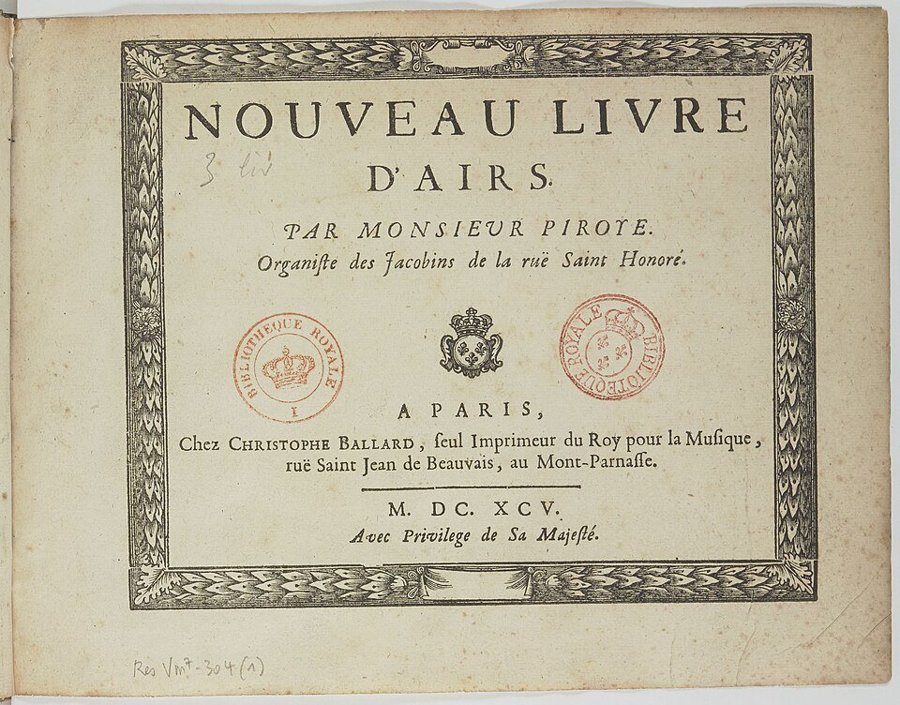
Image: BnF (Gallica bpt6k45004842), Wikimedia Commons, domaine public
A pupil of Lully and Michel Lambert, Piroye was organist of the Jacobins church in the rue Saint-Honoré from 1690 to 1712. His Pièces choisies for organ and harpsichord (1712) show a personal style closer to Charpentier than to his teachers.
The repertoire
Works in the project’s repertoire
1 work, available to listen to.
Core repertoire
This classification reflects the place of these repertoires within the artistic and educational orientations of the project. It does not constitute a technical indication regarding the design of the instrument.
Biography
Life and organ music
Charles Piroye, organist of the Jacobins in the rue Saint-Honoré in Paris for more than twenty years, and then of the church of Sainte-Catherine in Lille, where he died on 3 March 1724, left for the organ only five large pieces published in 1712 and a sixth known from a copy. They are pieces with descriptive titles, built as dialogues between the manuals, which depart from the usual forms of the French school.
Key dates
- c. 1665–1672
- Born, perhaps in Paris (date disputed)
- 1690
- Organist of the Jacobins, rue Saint-Honoré
- 1695
- First of three books of airs sérieux et à boire (1695–1697)
- 1708
- Organist of Saint-Honoré
- 1712
- Pièces choisies for organ and harpsichord
- 25 February 1713
- Second marriage, at Versailles
- 3 March 1724
- Death in Lille
A little-known life
His date of birth has not been established. The French Wikipedia article gives c. 1665, as does the Dictionnaire de la musique en France edited by Marcelle Benoit; Grove places his birth between 1668 and 1672, and the authority record of the BnF keeps to “167.”. He may have been born in Paris, where his father, Edmé Piroye, was a master harness-maker. A widower from his first marriage, to Étiennette Hélène Cordesse, by whom he had a son, Charles, who also became a master harness-maker, he remarried on 25 February 1713 at Versailles, to Élisabeth Amaury, who survived him.
The preface to his Pièces choisies describes him as a pupil of Lully and Michel Lambert. The English article observes, however, that some of his surviving works suggest less the influence of these teachers than that of Marc-Antoine Charpentier.
Organist in Paris
From 1690 to 1712 Piroye was organist of the Jacobins church in the rue Saint-Honoré; from 1708 he also played the organ of Saint-Honoré, until 1712 according to the French and English articles, until 1717 according to the BnF. The French article reports that he was dismissed, for an unknown reason, on a 22 February, and replaced by Pierre-Claude Foucquet, then only eighteen. A tax register of 1695 places him among the organists of the second rank, the first including François Couperin and Louis Marchand.
He was publishing by 1695: three books of airs sérieux et à boire with Ballard (1695–1697), nine airs in the same publisher’s anthologies, a Cantique pour le temps de Noël (1703) and Le Retour d’Eurydice aux Enfers, a sequel to Clérambault’s cantata Orphée. He also composed a tragédie en musique, Jephté (1703), and a plainchant mass, which remained in manuscript. A first book of harpsichord pieces is lost.
The Pièces choisies of 1712
In 1712 there appeared in Paris the Pièces choisies de la composition de Mr Piroye, professeur de musique & organiste à Paris, tant pour l’orgue et le clavecin, que pour toutes sortes d’instruments de musique. The first book contains five organ pieces: La Paix, L’Allégresse, La Béatitude, L’Immortelle and La Brillante. For the most part they are not fugues, hymn versets or trios: the English article sees them as dialogues between the different divisions of the organ, reaching well beyond the tradition of the French school of their time.
The preface praises “his learned and delicate manner of playing the organ and the harpsichord”, which “each day earns him new applause”, and announces further volumes, to appear every three months, for organ, harpsichord, theorbo, violin and other instruments; they were not published, or have not been found. A sixth piece, La Royale, is known from a manuscript copy by Delmotte published in 1984 in an organ book from Entrevaux; the English article counts it among the titles of the Pièces choisies.
Lille and the end
Piroye ended his career in Lille, as organist of the church of Sainte-Catherine; the BnF also makes him maître de chapelle of that church, perhaps from 1717, and the French article shows him as teacher of the young ladies Noiret de Saint-Antoine. The burial record, kept in the departmental archives of the Nord, describes him as “Dominus Carolus Piroÿt, organistus, cantor expertissimus hujus ecclesiae” and dates it 3 March 1724. Grove still placed his death only between 1717 and 1730.
In 1732 Titon du Tillet listed him, in his Parnasse françois, among “our most skilful organists whom death has taken from us”, with the title of “organist of the church of the Reverend Jacobin Fathers, rue Saint-Honoré”. Charles Bouvet devoted an article to him in the Revue de musicologie in 1928, “Un musicien oublié: Charles Piroye”.
Take part
This organ will be able to serve this music.