Baroque · French
André Raison
around 1640 to 1719
French Classical
Core repertoire
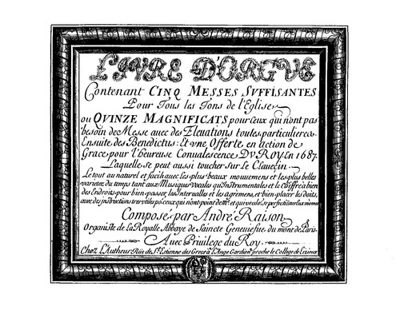
Image: Wikimedia Commons (PDF, page 1) ; exemplaire BnF, domaine public
Organist of the abbey of Sainte-Geneviève in Paris, André Raison published two books of organ music (1688 and 1714). The first, entirely liturgical, and its preface constitute a precious testimony to the practice of French classical organ music.
« Mais, du moins, la grâce de certains motifs, le charme de courtes pièces aux proportions exactes nous donnent à louer, dans son œuvre, ce que les contemporains n’eussent peut-être pas songé à y remarquer. »
English translation: “Yet at least the grace of certain motifs and the charm of short pieces in exact proportions give us cause to praise in his work what his contemporaries would perhaps never have thought to notice in it.”
The repertoire
Works in the project’s repertoire
11 works, 10 of them available to listen to.
Core repertoire
Flagship work
Premier Livre d’orgue — Messe du Deuxième ton
Mass · Early edition
Contains the famous Christe Passacaglia whose bass was borrowed by J.S. Bach (BWV 582), fully exploits French Classical registrations
Flagship work
Premier Livre d’orgue — Messe du Premier ton
Mass · Early edition
Written specifically for the French Classical organ, in its liturgical forms
Deuxième Livre d’orgue — Noëls variés
Noël
Typically French genre, the varied registrations ideally exploit a Classical instrument
Premier Livre d’orgue — Messe du Huitième ton
Mass · Early edition
Written specifically for the French Classical organ, in its liturgical forms
Premier Livre d’orgue — Messe du Sixième ton
Mass · Early edition
The Christe Chaconne exploits foundation stops and mutations in exemplary fashion
Premier Livre d’orgue — Messe du Troisième ton
Mass · Early edition
High-quality liturgical pieces, perfectly idiomatic for the French organ
This classification reflects the place of these repertoires within the artistic and educational orientations of the project. It does not constitute a technical indication regarding the design of the instrument.
Biography
Life and organ music
André Raison held the organ of the abbey of Sainte-Geneviève in Paris for some fifty years, and later that of the Jacobins in the rue Saint-Jacques as well. Neither the place nor the date of his birth is known, and his secluded life left few traces. What remains are two organ books, of 1688 and 1714: the first, with its preface, is one of the most precise accounts of how the organ was played in France at the end of the 17th century.
Key dates
- c. 1640–1650
- Birth, place disputed (Nanterre, Meaux or Paris according to the sources)
- c. 1665–1666
- Organist of the abbey of Sainte-Geneviève, Paris
- 30 January 1687
- Louis XIV at the Hôtel de Ville: the offertory “Vive le Roy des Parisiens”
- 1688
- Livre d’orgue contenant cinq messes
- 1710
- Clérambault dedicates his Premier livre d’orgue to him; Raison is also organist of the Jacobins
- 1714
- Second livre d’orgue sur les acclamations de la paix
- 1719
- Death in Paris (between 1714 and 1720 according to Pirro)
A life little known
André Pirro, who wrote the notice for the second volume of the Archives des maîtres de l’orgue in 1899, could not even fix “the exact limits of his life”: he dated him “16..? – 17..?”. Present-day sources agree no better. The French Wikipedia article has him born around 1650 and says he came from Meaux; the English article places his birth in the 1640s, possibly in or near Nanterre, the German one around 1640 in Nanterre; the authority record of the BnF gives Paris and notes that dictionaries hesitate between “c. 1650”, “before 1650” and the first half of the century. Pirro already thought the date of 1650 should be moved several years earlier, since Raison had been organist of the abbey since 1665 or 1666. He also rejected Fétis’s claim that he was a pupil of Titelouze, who died in 1633, and found no evidence for the hypothesis that he was born in Rouen.
Raison himself says, in the preface of 1688, that he was educated at Nanterre, by the canons regular of Sainte-Geneviève, who ran a seminary and a school there.
Organist of Sainte-Geneviève
Appointed around 1665–1666 to the abbey of Sainte-Geneviève in Paris (the French article places the abbey at Nanterre, where he had been trained), he lived close by in the rue Saint-Étienne-des-Grès, first in the house at the sign of the Guardian Angel, then, after 1687–1688, in a larger house on the corner of the rue des Cholets, known as the Sacrifice of Abraham. Pirro notes that at the procession of the shrine of St Genevieve the organist received a share of blessed bread, a holy picture and three livres. In 1695 a tax roll ranks him among the leading organists of Paris, with François Couperin, Jean-Henri d’Anglebert, Nicolas Gigault, Nicolas de Grigny and Louis Marchand.
No journey or organ inspection of his is known, and he probably never played at court. A note of 17 June 1689, written at the request of the builder Clicquot, answers questions on the layout of the Positif of the abbey organ, whose chorus, he says, “accompanies that of the Grand-Orgue very well”. He also held the organ of the Jacobins in the rue Saint-Jacques, a title he already bore in 1710 and joined to that of the abbey in 1714. Among his pupils was Louis-Nicolas Clérambault, who dedicated his Premier livre d’orgue to him in 1710 in gratitude for his “learned lessons”.
The organ book of 1688
The Livre d’orgue contenant cinq messes suffisantes pour tous les tons de l’Église, published by the author, was written for monks and nuns whose enclosure prevented them from hearing the best organists. The masses, on the first, second, third, sixth and eighth tones, all follow the same plan, from five versets for the Kyrie to a Deo gratias; they can also serve as fifteen Magnificat settings. An offertory on the fifth tone, “Vive le Roy des Parisiens”, celebrates Louis XIV’s entry into the Hôtel de Ville on 30 January 1687, after his recovery.
The preface marks the ornaments and fingerings and asks the player to recognise in each piece the movement of a dance, sarabande, gigue, gavotte, passacaille or chaconne, and to give it “the same air as you would give it on the harpsichord, except that the beat must be a little slower on account of the holiness of the place”. The Christe of the second-tone mass is a trio en passacaille whose bass Bach took up in his Passacaglia in C minor, BWV 582; Pirro considered it impossible to say whether he had it from Raison or from a traditional formula. Above all, Pirro praised “the grace of certain motifs and the charm of short pieces in exact proportions”, which contemporaries would perhaps not have noticed.
The second book and the end
The Second livre d’orgue sur les acclamations de la paix tant désirée (1714) greets the Peace of Utrecht, or perhaps that of Rastatt according to the English article: an antiphon Da pacem Domine with its fugue, an offertory, an overture on the seventh tone with wishes for a long life to the king, an allemande, and then noëls with variations “in the taste of the time”, for organ or harpsichord. The collection was rediscovered only in the 20th century.
Titon du Tillet does not name him in his Parnasse françois (1732), nor does Daquin’s son in his Lettres sur les hommes célèbres. Present-day articles have him die in Paris in 1719; Pirro, who knew of no death record, placed his death between 1714 and 1720. Louis-Antoine Dornel, who was already deputising for him, succeeded him at Sainte-Geneviève, and Clérambault at the Jacobins.
Sources
- André Pirro, notice “André Raison”, with the preface “Au lecteur” of the 1688 book, Archives des maîtres de l’orgue, vol. 2, Paris, Durand, 1899 (Internet Archive)
- Wikipedia (French), “André Raison”, consulted November 2026
- Wikipedia (English), “André Raison”, consulted November 2026
- Wikipedia (German), “André Raison”, consulted November 2026
- Wikipedia (French), “Louis-Antoine Dornel”, consulted November 2026
- Bibliothèque nationale de France, authority record “Raison, André (16..-1719)”
The sources
Digitised collections
Early editions and manuscripts containing works by this composer, digitised by libraries and available in full.
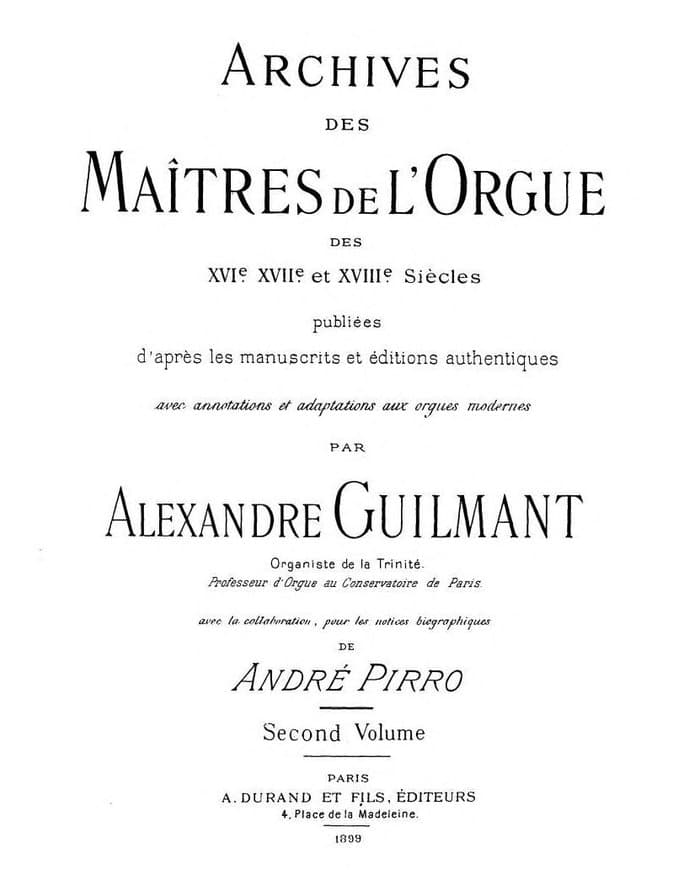
Archives des maîtres de l’orgue des XVIe, XVIIe et XVIIIe siècles (ed. Alexandre Guilmant and André Pirro), second volume: Livre d’orgue d’André Raison
Paris, A. Durand et fils, 1899
Internet Archive
Biographical notice by André Pirro (1899), missing from this copy, available in another digitised copy of the same volume. Read the notice
Take part
This organ will be able to serve this music.