Classical · French
Claude Balbastre
1724 to 1799
French Classical
Core repertoire
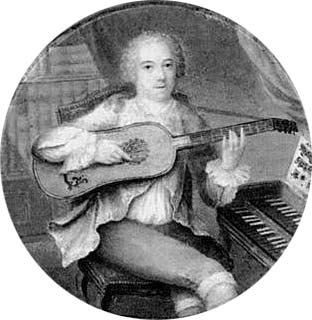
Born in Dijon and a pupil of Claude Rameau, Balbastre made his Paris debut at the Concert Spirituel in 1755 and became one of the most famous organists of his day, at Saint-Roch and then at Notre-Dame de Paris. His Recueil de noëls formant quatre suites (1770), written for harpsichord and fortepiano, continues the French tradition of the noël with variations.
Wikipedia Scores on IMSLP Report an error
Organ loftsNotre-Dame Cathedral, Chapelle royale
The repertoire
Works in the project’s repertoire
5 works, 4 of them available to listen to.
Core repertoire
Repertoire in dialogue
Flagship work
Recueil de Noëls formant quatre suites, avec des variations
Noël
Written for harpsichord and fortepiano, played on the organ from the outset
This classification reflects the place of these repertoires within the artistic and educational orientations of the project. It does not constitute a technical indication regarding the design of the instrument.
Biography
Life and organ music
Claude Balbastre was born in Dijon on 8 December 1724, the son of an organist of the cathedral. Organist of that cathedral in his turn, he settled in Paris in 1750, triumphed at the Concert Spirituel, held the organs of Saint-Roch and Notre-Dame and taught the harpsichord at court. He came through the Revolution playing revolutionary hymns at Notre-Dame and died in Paris in 1799. His four suites of noëls, published in 1770, remain in the organist’s repertoire.
Key dates
- 8 December 1724
- Born in Dijon (1727 in older dictionaries, through confusion with a brother)
- 1743
- Organist of Dijon Cathedral
- 1749
- Book of organ and harpsichord pieces, known as the Versailles manuscript
- 21 March 1755
- Debut at the Concert Spirituel
- 1756
- Organist of Saint-Roch (1751 according to the German article)
- 1760
- Organist of Notre-Dame de Paris
- 1770
- Recueil de noëls formant quatre suites
- 9 May 1799
- Death in Paris
Dijon
He was baptised on 9 December 1724 in the church of Saint-Michel in Dijon. His father, Bénigne Balbastre, organist at the cathedral, had eighteen children by two marriages, of whom he was the sixteenth; three of his brothers were also named Claude. He has long been confused with one of them, Claude-Bénigne, born on 22 January 1727 who died young, which explains the date of 1727 given by several dictionaries and the compound first name under which he is often cited; the BnF authority record gives 1724, and the English article states that the discovery of the baptismal entry has settled the date.
His father was his first teacher. On his death, when the boy was thirteen, his teaching passed to Claude Rameau, the younger brother of Jean-Philippe Rameau, who succeeded the father in the organ loft; Balbastre himself took over the cathedral organ in 1743, following his teacher. The German article, on the contrary, has him succeed his father directly at the age of thirteen. In 1749 he gathered seventy-six pieces in a Livre contenant des pièces de différent genre d’orgue et de clavecin, signed “organiste de la cathédralle de Dijon”; this manuscript, known as the Versailles or Dijon manuscript, contains among other things a concerto in D major, the only one of his fourteen organ concertos to have been found.
Paris: Saint-Roch and Notre-Dame
He settled in Paris in 1750; Jean-Philippe Rameau, according to the English and German articles, helped him to become known in high society there. On 21 March 1755 he made his debut at the Concert Spirituel with a much admired organ concerto, and according to the English article he went on appearing there until 1782. At Saint-Roch, where according to the English article he succeeded Pierre Février, with whom he had studied, he was appointed in 1756 according to the French article, as early as 1751 according to the German one. In 1760 he became organist of Notre-Dame. He was harpsichordist at court, where he taught Marie-Antoinette, teacher of the Duc de Chartres, organist to the Comte de Provence, the future Louis XVIII, and received a quarter at the Chapelle Royale; the French article places these posts from 1776 onwards, the German one partly as early as 1766.
His playing drew crowds, so much so that in 1762 the Archbishop of Paris forbade him to play at midnight Mass, “because of the multitude who came to hear the organist and did not keep the respect due to the holiness of the place”; in 1766 he also banned his Te Deum settings on the eve of St Roch. In 1763 he married Marie-Geneviève Hotteterre, of the family of musicians, who died soon afterwards, and in 1767 Marie-Antoinette Boileau.
Burney’s account
On 17 June 1770 the English composer and writer Charles Burney left a dinner early to hear him at Saint-Roch. During the Magnificat, he reports, Balbastre played between the verses minuets, fugues, imitations, even hunting pieces and jigs, without the congregation appearing to take offence. At his home in the rue d’Argenteuil Burney admired a Ruckers harpsichord painted like a snuff-box, its lid depicting Rameau’s Castor et Pollux, and a large practice organ with pedals, “too large and coarse for a chamber”. He noted with pleasure the friendship between Balbastre and Armand-Louis Couperin.
The noëls and the Revolution
After a book of harpsichord pieces in 1759, Balbastre published in 1770 his Recueil de noëls formant quatre suites, avec des variations, pour le clavecin et le forte-piano. The twenty-three noëls, from “À la venue de Noël” and “Joseph est bien marié”, which open the first suite, to “Or nous dites Marie”, which opens the fourth, are nevertheless “clearly in the tradition of the French organ”, as the French article notes; Balbastre himself played them with great success on the fortepiano in aristocratic salons. Organists have since taken them up widely.
During the Revolution he rallied, at least outwardly, to the new ideas. In 1793 he published the Marche des Marseillois et l’air Ça ira “by Citizen Balbastre”, and at Notre-Dame, now the Temple of Reason, he played his arrangements of revolutionary hymns. The sources disagree on his situation: according to the French article he kept his post at Notre-Dame; according to the English one he lost his official posts and, for a time, his pension; according to the German one he grew poor but remained organist of Notre-Dame. He died on 9 May 1799 (20 Floréal Year VII), in the rue d’Argenteuil, in the parish of Saint-Roch, “forgotten by all” according to the French article.
Sources
- Bibliothèque nationale de France, authority record “Balbastre, Claude (1724-1799)”, noting the confusion between the two brothers
- Wikipedia (French), “Claude Balbastre”, consulted November 2026
- Wikipedia (English), “Claude Balbastre”, consulted November 2026
- Wikipedia (German), “Claude Balbastre”, consulted November 2026
- IMSLP, “Recueil de Noëls”, title and date of publication (1770, Paris, published by the composer)
Take part
This organ will be able to serve this music.