Baroque · Danish-German
Dietrich Buxtehude
around 1637 to 1707
North German Baroque
Repertoire in dialogue
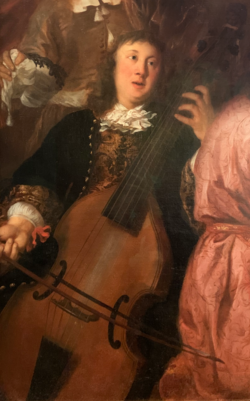
Organist of the Marienkirche in Lübeck for nearly forty years, Buxtehude was the leading representative of the North German organ school. His préludes, toccatas, and chaconnes profoundly influenced the young Bach, who travelled on foot from Arnstadt to Lübeck in 1705 to hear him.
The repertoire
Works in the project’s repertoire
15 works, all available to listen to.
Repertoire in dialogue
This classification reflects the place of these repertoires within the artistic and educational orientations of the project. It does not constitute a technical indication regarding the design of the instrument.
Biography
Life and organ music
Dietrich Buxtehude, born around 1637 in what was then Denmark, was organist of St Mary’s in Lübeck for nearly forty years, from 1668 until his death in 1707. There he made the Abendmusiken, the evening concerts of Advent, into one of the city’s institutions. None of his organ pieces was printed in his lifetime, and not one survives in his own hand; yet they form one of the largest bodies of German organ music before Bach. In 1705 the young Bach travelled on foot from Arnstadt to hear him.
Key dates
- c. 1637
- Birth, probably in Helsingborg (Oldesloe or Helsingør according to others)
- 1657–1658
- Organist of St Mary’s, Helsingborg
- 1660
- Organist of St Mary’s, Helsingør
- 11 April 1668
- Succeeds Franz Tunder at St Mary’s, Lübeck
- 1673
- First mention of the Abendmusiken by that name
- August 1703
- Visit of Mattheson and Handel
- late 1705
- Bach’s stay in Lübeck, nearly three months
- 9 May 1707
- Death in Lübeck
A disputed origin
The date and place of his birth remain uncertain. His obituary, published in Lübeck in July 1707, says that he “acknowledged Denmark as his native country” and lived about seventy years. Johann Moller had him born in 1637 at Helsingør (Elsinore); André Pirro, in the monograph he devoted to him in 1913, thought Helsingborg more likely, in Scania, then Danish, where his father was organist in 1641, and this is the most widely held view today. Others suggest Oldesloe in Holstein, where his father came from, and which the BnF authority record adopts. The English Wikipedia article calls him a Danish composer, the French one German of Danish descent, the German one Danish-German.
His father, Johannes Buxtehude, organist of St Mary’s in Helsingborg and then of St Olaf’s in Helsingør, was his first teacher. The boy grew up in Helsingør, where he may have attended the Latin school; he probably witnessed the rebuilding of the St Olaf’s organ by Johann Lorentz in 1649–1650.
Helsingborg and Helsingør
He was organist of St Mary’s in Helsingborg, recorded in 1658 and probably in post from 1657, in a region ravaged by war between Denmark and Sweden. In 1660 he succeeded Claus Dengel at St Mary’s in Helsingør, for a much higher salary; it is the only one of his churches whose organ remains in its original place, the Helsingborg organ having been moved to the church of Torrlösa.
St Mary’s, Lübeck
Franz Tunder died on 5 November 1667; after several unsuccessful auditions, Buxtehude succeeded him on 11 April 1668. He became a citizen of the city in July and on 3 August married Anna Margaretha, Tunder’s daughter; they had seven daughters. Organist of the city’s principal church, he was also its Werkmeister, responsible for administration and accounts. He played at the Sunday and feast-day services and at the vespers of the day before, on the large organ and, for certain ceremonies, on the small organ of the Dance of Death chapel.
He took over and transformed the Abendmusiken, evening concerts given after the afternoon service between Martinmas and Christmas. Tunder had begun them around 1646; the name appears in 1673. In 1669 Buxtehude had two additional galleries built, bringing the number of singers and instrumentalists to about forty; from 1682 the town watch had to keep order. The concerts, which charged no admission, lived on private donations. Buxtehude gave large works there spread over five Sundays, such as Die Hochzeit des Lammes in 1678, of which only the libretto survives. The tradition lasted until 1810.
He kept company with Johann Adam Reinken in Hamburg and was in touch with Gustav Düben in Stockholm, to whom he dedicated the Membra Jesu nostri in 1680; Johann Pachelbel dedicated his Hexachordum Apollinis to him in 1699. His pupils included Daniel Erich, Ludwig Busbetzky, Georg Dietrich Leyding and above all Nicolaus Bruhns, who arrived in 1682.
The organ works
The catalogue drawn up by Georg Karstädt in 1974 (BuxWV) lists eighty-nine organ pieces, known only from copies: Johann Gottfried Walther for the chorale settings, Gottfried Lindemann for the free works, and the manuscript of Johann Christoph Bach, Johann Sebastian’s elder brother, which preserves the three ostinato pieces and the Prelude, Fugue and Chaconne in C major, BuxWV 137. The preludes alternate improvisatory passages in the stylus phantasticus with fugues, several of them in five sections; for the Prelude in F sharp minor, BuxWV 146, a key rarely used at the time, he is thought to have tuned the organ in his own way, according to the English article. In the chorale settings he ornaments the melody in the soprano in some thirty chorale preludes, and develops each line of the text in large fantasias such as Nun freut euch, lieben Christen g’mein or Wie schön leuchtet der Morgenstern. The two chaconnes, in C minor and E minor, and the Passacaglia in D minor, BuxWV 161, whose ostinato moves through D minor, F major and A minor before returning to D minor, were to hold the attention of Bach and later of Brahms.
Mattheson, Handel, Bach
In August 1703 Johann Mattheson and George Frideric Handel came to Lübeck, invited by the council, which was concerned about the succession; according to Mattheson, the successor was to marry one of the organist’s daughters, and both left. At the end of October 1705, Pirro writes, Johann Sebastian Bach obtained four weeks’ leave from Arnstadt and set out on foot; he stayed nearly three months. He very probably heard the two extraordinary concerts of 2 and 3 December 1705, Castrum doloris for the death of Emperor Leopold I and Templum honoris for Joseph I, whose music is lost. On his return he had to justify the length of his absence; he had wanted, he said, “to comprehend one thing and another about his art”. Nothing supports Spitta’s idea that Buxtehude offered him the post on the same condition.
Buxtehude chose Johann Christian Schieferdecker as his successor, who married his eldest daughter. He died on 9 May 1707 and was buried on the 16th in St Mary’s. Philipp Spitta, while studying Bach, rediscovered his organ works and published them from 1873.
Sources
- André Pirro, Dietrich Buxtehude, Paris, Fischbacher, 1913 (Internet Archive)
- Wikipedia (French), “Dietrich Buxtehude”, consulted November 2026
- Wikipedia (English), “Dieterich Buxtehude”, consulted November 2026
- Wikipedia (German), “Dieterich Buxtehude”, consulted November 2026
- Bibliothèque nationale de France, authority record “Buxtehude, Dietrich (1637?-1707)”
The sources
Digitised collections
Early editions and manuscripts containing works by this composer, digitised by libraries and available in full.
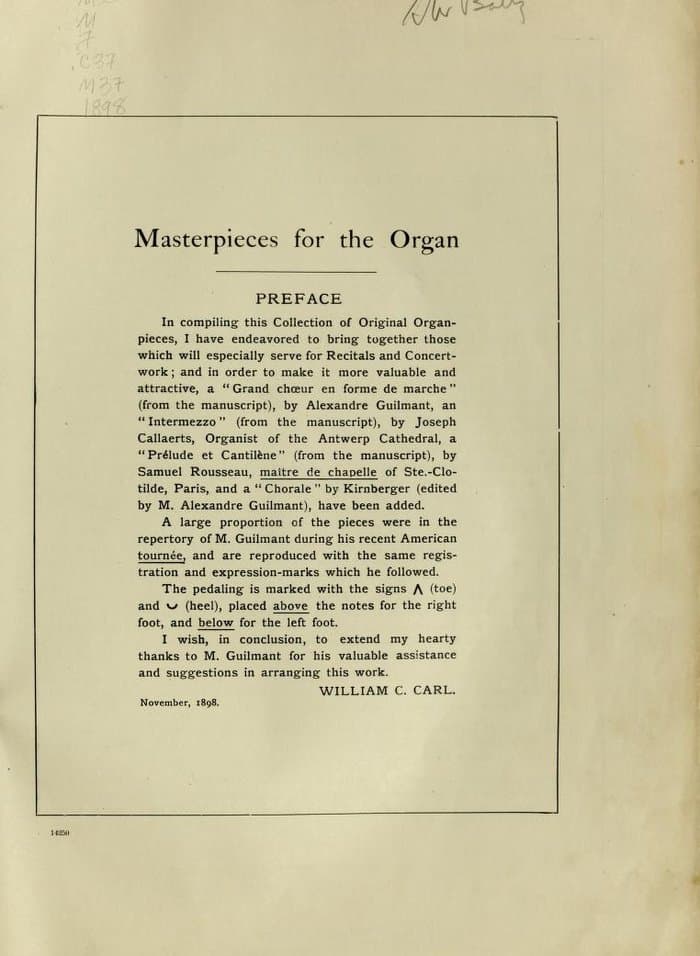
Master-pieces for the organ: twenty-one organ works selected chiefly from the programs of Alexandre Guilmant (ed. William C. Carl)
New York, G. Schirmer, 1898
Copy: Brigham Young University, Harold B. Lee Library, via Internet Archive
Take part
This organ will be able to serve this music.