Baroque · French
Nicolas Gigault
1627 to 1707
French Classical
Core repertoire
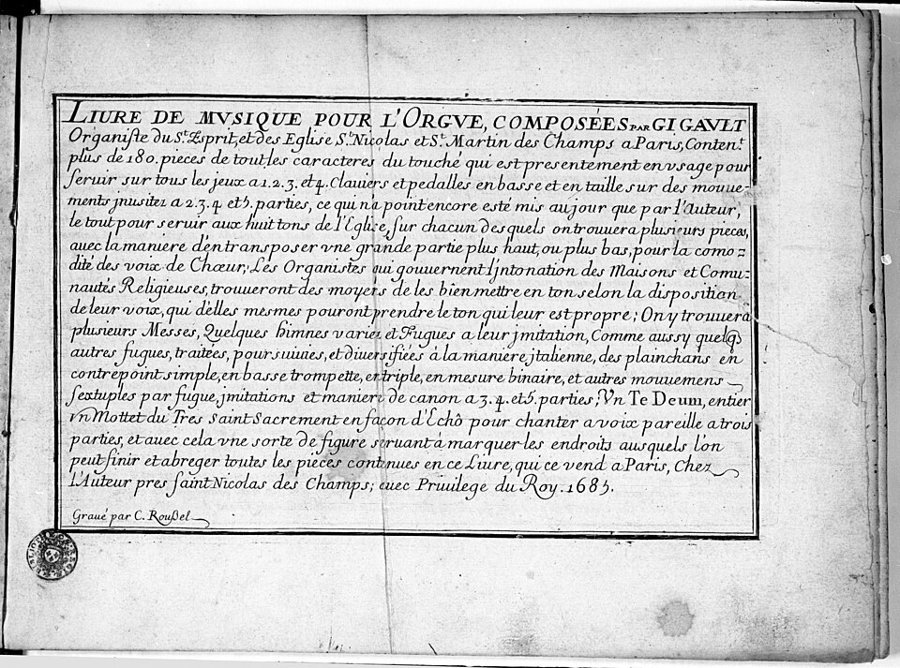
Image: BnF (Gallica btv1b9010079z), Wikimedia Commons, domaine public
Organist of Saint-Nicolas-des-Champs in Paris from 1652, Gigault belongs, with Nivers and Lebègue, to the first generation of the French Classical organ school. His Livre de musique dédié à la Très Sainte Vierge (1682) contains the earliest known noëls with variations; his Livre de musique pour l’orgue (1685) gathers 184 liturgical pieces.
The repertoire
Works in the project’s repertoire
6 works, 4 of them available to listen to.
Core repertoire
This classification reflects the place of these repertoires within the artistic and educational orientations of the project. It does not constitute a technical indication regarding the design of the instrument.
Biography
Life and organ music
Nicolas Gigault was born in 1627 or shortly after, in or near Paris, into a poor family. Organist of Saint-Nicolas-des-Champs for half a century, he held several Parisian organ posts at once and published two collections: in 1682 a book of noëls, the earliest known noëls with variations, and in 1685 a Livre de musique pour l’orgue of 184 pieces. With Nivers and Lebègue, he belongs to the first generation of the French classical organ school.
Key dates
- 1627
- Birth, no earlier than this year (1624–1625 according to Pirro)
- 1646
- Organist of the collegiate church of Saint-Honoré
- 1652
- Organist of Saint-Nicolas-des-Champs
- 1662
- Marriage to Marie Aubert
- 1673
- Organist of Saint-Martin-des-Champs
- 1682
- Livre de musique dédié à la Très Sainte Vierge (noëls)
- 1685
- Livre de musique pour l’orgue; organist of the Hôpital du Saint-Esprit
- 20 August 1707
- Death in Paris
A youth without fortune
Little is known of his life. Fétis said he was born at “Clayes-en-Brie”, a place whose name cannot be found; the French Wikipedia article gives Claye, near Paris, and the BnF Paris. André Pirro placed his birth in 1624 or 1625, and Charles Bouvet, in 1919, still gave 1625; a later study by Pierre Hardouin, cited by the English article, showed that he cannot have been born before 1627.
His father, Estienne Gigault, was a bailiff at the Paris law courts. Nicolas lost his mother as a child, and the family remained in straitened circumstances: as late as 1648 he and his two younger brothers renounced their father’s estate so as not to inherit his debts. His training is unknown. Pirro suggested several possible teachers, among them Charles Racquet, but no document attests such lessons; the English article dismisses the idea, going back to Fétis, that he studied with Titelouze, Gigault being too young and his family too poor for journeys to Rouen.
The Parisian organ lofts
His known career began in 1646 at the collegiate church of Saint-Honoré. In 1652 he moved to Saint-Nicolas-des-Champs, which he kept until 1701 according to the French article, when his son Anne-Joachim succeeded him, and until his death according to the English article. There he worked alongside Étienne Richard, organist of Saint-Martin-des-Champs until his death in 1669; Gigault in turn held the organ of Saint-Martin-des-Champs from 1673, then that of the Hôpital du Saint-Esprit from 1685. He was also consulted as an organ expert and sought after as an instrumentalist. Lully is said to have been his pupil, and according to the French article he sat on the jury which in 1706 gave Rameau the organ of Sainte-Madeleine-en-la-Cité.
In 1662 he married Marie Aubert, who bore him five children; his two sons, Anne-Joseph and Anne-Joachim, became organists, and his youngest daughter married an organ builder. The inventories drawn up in 1662 and 1700 show that he was no longer poor: his house held paintings, most of them devotional, and many instruments, a chamber organ, two harpsichords, three spinets, two clavichords, viols, a theorbo and a guitar. Widowed on 7 August 1700, he remarried and died in Paris on 20 August 1707; the English article, which gives that date at the outset, later says 7 August.
The book of noëls of 1682
The Livre de musique dédié à la Très Sainte Vierge gathers, in two parts, the carols “sung in honour of her divine childbearing”, varied in two, three and four parts; the French article counts seventeen noëls, the English twenty. They are the earliest known examples of the varied noël: each carol moves from two to four voices, with a rather rigid variation technique. The title states that they may be played on the organ and harpsichord, but also on the lute, viols, violins or flutes. An allemande unconnected with Christmas is given twice, plain and then “with the ports de voix”, as a model of ornamentation.
The Livre de musique pour l’orgue
The collection of 1685 contains 184 pieces. It opens with the masses, two according to the French article, three according to the English, which describes two large masses of more than twenty pieces each and a very short one of seven versets; the plainchant is not merely held in long notes but paraphrased or turned into fugue subjects. There follow pieces arranged by mode and three hymns, Pange lingua, Veni Creator and a complete Te Deum. In his preface Gigault announces a Pange lingua in three parts in diminution and another in four in the form of a canon, “with a fugue in imitation of it, whose verses are fugued in the manner of the late Monsieur Titelouze”. He also presents “several compositions in five parts, which had never yet been attempted on the organ”: the plainchant in the pedal, in the tenor, beneath the four manual parts. Bouvet noted that when he occasionally wrote in six parts he gave two of them to the pedal, so as to leave the hands a perfect legato.
The music, closer to the style of 1650 to 1675 than to that of the end of the century, may draw on earlier pieces. It is notated with unusual care, is full of notes inégales and uses the word fugue in a broad sense, “fugue à 2” for a duo. Often judged harshly, it has a grave character, more suited to the church, according to the English article, than that of Lebègue. The French article places Gigault, with Nivers and Lebègue, in the generation that moved beyond the strict polyphony of Titelouze, Racquet or Roberday towards a more instrumental style. Alexandre Guilmant republished the book in 1902 in the Archives des maîtres de l’orgue.
Sources
- Wikipedia (French), “Nicolas Gigault”, consulted November 2026
- Wikipedia (English), “Nicolas Gigault”, consulted November 2026
- Wikipedia (French), “Jehan Titelouze” (quotation from the 1685 preface), consulted November 2026
- Charles Bouvet, Une dynastie de musiciens français : les Couperin, organistes de l’église Saint-Gervais, Paris, Delagrave, 1919, preface, pp. v–vi (Internet Archive)
- Bibliothèque nationale de France, authority record “Gigault, Nicolas (1627?-1707)”
Take part
This organ will be able to serve this music.